Silence is Golden

Back in the early 1980s, when I was a young cub reporter fresh out of college covering the bond market for a Wall Street trade newspaper, I used to scratch my head over how traders and investors would try to discern what the next Federal Reserve move would be. Obviously, not much has changed since then.

Back then, however, the Fed rarely said anything, and when it did, its words would be couched in the famous “Fed speak,” in which the chairman – Alan Greenspan was the best (or worst) at it – said a bunch of gobbledygook that few people could understand but spent countless hours trying to decipher.

In my innocence, I asked one of the senior reporters, “Why doesn’t the Fed just tell us what it intends to do instead of making everybody guess?” I don’t remember ever getting a good explanation.

The problem with that type of “communication” – or lack of it – is that investors are prone to make panicky, knee-jerk reactions to whatever the Fed eventually does.

Since then, the Fed, to its credit, has made a real, concerted effort to become “more transparent” in its communications and avoid surprises as much as it can. The process started with Ben Bernanke, and Jerome Powell has really run with it, holding a press conference after every Fed meeting, or 10 times a year, rather than quarterly as his immediate predecessors did. That’s on top of the countless public speeches and congressional appearances he makes, plus those of the other members of the Fed’s Board of Governors and the presidents of the regional Fed banks, those with a vote on monetary policy.

Now, it seems, we’re at the point where the Fed is confusing the markets by having too many voices say too many things, rather than confusing the markets by saying as little as possible. Which situation is better, I’m not sure.

Case in point: Continue reading "Silence is Golden"
And Still, We Wait

Hello traders everywhere. "We were about 90% of the way there (with a deal) and I think there’s a path to complete this," Mnuchin told CNBC's Hadley Gamble on Wednesday, without providing detail on what the final 10% of an agreement might entail. He said he's confident President Donald Trump and Chinese President Xi Jinping can make progress in stalled trade talks at the forthcoming Group of 20 (G-20) meeting this weekend. Yet, here we are still waiting on a trade deal with China.

We're also still waiting on a decision from a confused Fed. Investors are betting the Fed will cut rates by at least 25 basis points in July. Those expectations helped lift the major stock indexes this month. The Dow and S&P 500 were both up at least 6% for June entering Wednesday’s session. The Nasdaq was up 5.8%. Continue reading "And Still, We Wait"

Gold Bugs, How Deep Is Your Love?

The title of my previous update was “Calm Before Storm”, and it was not “clickbait” as I spotted a telling market structure that appeared on the chart as a huge visible consolidation had emerged.

Indeed, a sharp move higher followed that post after the consolidation mentioned above had broken out. That move was strong enough to overcome the barrier of the potential triangle’s resistance above $1360. This has invalidated the second option (green arrows) of intermediate triangular consolidation on our master chart. As time goes by, the dust settles, and the chart structure gets clearer eliminating one option after another until only one single way to go remains.

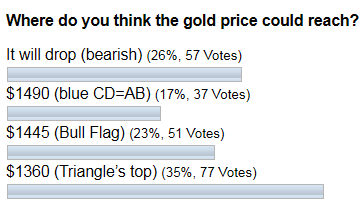
The gold advanced as high as $1437 so far, let’s see how you felt the market one month ago.

gold

Most of you thought that the triangle’s top could stop the market at the $1360 level, but at the same time, you were optimistic about the gold move although a bit conservative. It is interesting that in second place, the votes were given to an opposite bearish scenario. This confirms the idea that market forces are struggling during consolidation, as trading opinions are polar. There is a Bull Flag’s target on the third place, and it is the closest result so far, my congratulations to those who hit that option.

I cleaned the master chart below for you to focus only on one option, and I extended the view there. Continue reading "Gold Bugs, How Deep Is Your Love?"

ETFs Will End The Use Of Mutual Funds

When Jack Bogle started the Vanguard Index Fund, he essentially changed the investment management game forever. He found a way to reduce the fee’s they charged investors, which in turn, brought Vanguard more investment money than they could have ever imagined.

If the move to lower investment fees was the first landed punch in the fight against mutual funds, the rise of the Exchange Traded Fund is the nuclear bomb in the fight against mutual funds. And well to most market participants, the reason is clear, ETFs are way cheaper and easier for all parties involved.

But, why do lower fees matter? Yes, and the math, while perhaps not simple is straight forward. The idea is that if you invest the same amount each year, we will say $10,000, and in one scenario you pay 0.1% in fee’s and commissions and another you pay 1.5% in fees and commissions. Over 30 or 40 years of investing, the difference of 0.1% and 1.5% will add up because of compounding interest. How much of a difference, well that all depends on your annual return rate, how long you stay invested and how much you are investing, but it could add up to not thousands of dollars, or even hundreds of thousands of dollars, but millions of dollars.

Some quick back of the napkin math looks like this, just to prove my point. A 0.1% fee on $10,000 during one year is just $10. Now a 1.5% fee on $10,000 during one year is $150. Let’s say your account never grows higher than $10,000 over 10 years, (I know very unrealistic, but follow along.) If your fee’s where 0.1% you would pay $100 in fees throughout those 10 years, ($10 a year time 10 years). Now let’s say your fees where 1.5% on your $10,000 for 10 years, (and again it never changed from $10,000) you would pay $1,500 in fees over the 10 years. $100 in fees or $1,500 in fee’s, which would you rather pay? And again, that’s just on a $10,000 investment, imagine if you have $100,000, $500,000, $1 million or more invested. Continue reading "ETFs Will End The Use Of Mutual Funds"

Weekly Futures Recap With Mike Seery

Gold Futures

Gold futures in the August contract is currently trading at 1,400 hitting a 6 month high after settling last Friday in New York at 1,344 an ounce up over $55 for the trading week all on concerns of a conflict brewing with the country of Iran.

The U.S. dollar has hit a 3 month low as well as helping support prices as the fundamental situation for gold has changed very quickly as strong demand continues to push up prices. I am currently sitting on the sidelines in this market, but as I've written about in previous blogs, I still think gold is going higher as I see no reason to be short.

I have bullish recommendations in silver and Palladium as I'm keeping a close eye on platinum to the upside as the 10-year note hit 1.99% this week hitting a multi-year low as that is extremely supportive towards gold prices.

The next major level of resistance is around the 1,450 area as there is still room to run to the upside as you have to remember the all-time high was hit in September of 2011 above the 1,920 level and if you look at the monthly chart, in my opinion, it looks very bullish.

If you have a futures contract place the stop loss under the 10-day low which stands at 1,325 as an exit strategy, however, that will be raised daily starting next week.

TREND: HIGHER
CHART STRUCTURE: IMPROVING
VOLATILITY: HIGHER

Continue reading "Weekly Futures Recap With Mike Seery"