Weekly Futures Recap With Mike Seery

We've asked Michael Seery of SEERYFUTURES.COM to give our INO readers a weekly recap of the Futures market. He has been Senior Analyst for close to 15 years and has extensive knowledge of all of the commodity and option markets.

Michael frequently appears on multiple business networks including Bloomberg news, Fox Business, CNBC Worldwide, CNN Business, and Bloomberg TV. He is also a guest on First Business, which is a national and internationally syndicated business show.

Gold Futures

Gold futures in the April contract finished down about $4 for the week at 1,318 an ounce reversing earlier losses finishing strong especially compared to the rest of the commodity sectors. The U.S stock market sold off about 200 points as that supported gold prices as there were concerns earlier in the day about lower inflation estimates in Europe coupled with the fact that the U.S dollar also hit a 2 week high. However, investors came back into the market as a flight to quality. I have been recommending a bullish trade from around the 1,252 level, and if you took that trade, the stop loss has now been raised to 1,302 as the chart structure is outstanding. Gold prices are still trading above their 20 and 100-day moving average as the trend remain strong, but for the bullish momentum to continue, we have to break the January 31st high of 1,331 in my opinion. Let's see what Monday's trade brings as I think they'll be a lot of volatility because many government reports will finally be released.
TREND: HIGHER
CHART STRUCTURE: EXCELLENT
VOLATILITY: LOW

Continue reading "Weekly Futures Recap With Mike Seery"
Fed Chairman Powell Resuscitates Financial Cohort

The market-wide sell-off in the fourth quarter of 2018 was largely induced by the Federal Reserve and its alleged commitment to sequential interest rate increases into 2019. This was largely viewed as reckless and misguided while turning a blind eye to broader economic data-driven decision making about further interest rate hikes. The stock indices responded to the sequential interest rate hike stance with overwhelming negative sentiment, logging double-digit declines across the broader markets. Many market observers were questioning the Federal Reserve’s aggressive stance as companies issued weakness in ancillary economic metrics (slowing global growth, strong U.S. dollar, trade war, government shutdown, weak housing numbers, retail weakness, auto sluggishness, and oil decline) as an indication that cracks in the economic cycle were materializing. The strong labor market and record low unemployment served as a basis to rationalize increasing rates to tame inflation however these aforementioned economic headwinds appeared to cause the Federal Reserve to pivot in its aggressive stance. As Chairman Jerome Powell began to issue a softer stance on future interest rate hikes, January saw very healthy stock market gains after being decimated for months prior. On January 30th, Jerome Powell issued language that the markets were craving to levitate higher as he left interest rates unchanged and exercised caution and patience as a path forward. Using data-driven decision making as a path forward was cheered by market participants as the broader indices popped for healthy gains on top of the already robust gains throughout January.

Financial Cohort Squeezed

The financial cohort was stuck in a precarious situation in the latter half of 2018. On the one hand, a rising interest rate environment would provide boosts to bottom line revenue as a function of the increased rates on their deposit base. Banks had domestic and global economic expansion tailwinds at their back while posting accelerating revenue growth, increasing dividend payouts, engaging in a record number of share buybacks, benefiting from tax reform and deregulation. Augmenting this positive backdrop was a record number of IPOs, a record number of global merger and acquisitions along with consulting fees regarding mergers and acquisitions and trading around market volatility. All of these elements ostensibly provided an ideal confluence that boded well for the financial sector. JP Morgan (JPM), Citi (C), Wells Fargo (WFC), Goldman Sachs (GS) and Bank of America (BAC) seemed to be poised to continue to benefit from the favorable economic backdrop. Despite all these elements, 2018 was terrible for the financials which performed horribly, especially during the fourth quarter as rapid rate hikes were in the cards. Continue reading "Fed Chairman Powell Resuscitates Financial Cohort"

Weekly Losses In Sight For Stock Market

Hello traders everywhere. The three major indexes are set up to post losses for the third straight day to end the week. In fact, if the trend holds true through the close the S&P 500, DOW and NASDAQ will all post weekly losses. That would be the first weekly loss in seven weeks for the DOW and NASDAQ and it will be the second time in three weeks that the S&P 500 ended in negative territory.

Recent weakness has been brought about by skepticism over the United States and China reaching a trade deal before a looming deadline which has added to investor's nerves over slowing global growth.

Weekly Losses

The U.S. Dollar is on track for its best week in over six months posting a +1% gain on the week. This will be the biggest weekly increase since a 1.28% jump in the week of Aug. 10, 2018. This spike higher was brought on as investors flocked to the safe haven amid worries about a weakening global economy. Continue reading "Weekly Losses In Sight For Stock Market"

U.S. Crude Production Outperforms In November

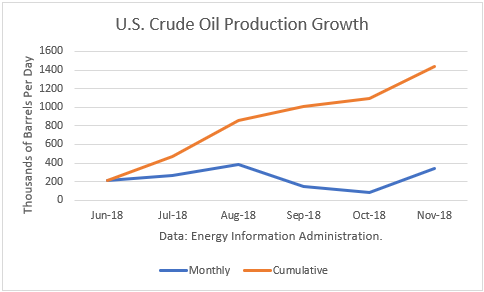
The Energy Information Administration reported that November crude oil production averaged 11.900 million barrels per day (mmbd), up 345,000 b/d from October. This estimate capped a spectacular 6-month gain of 1.436 mmbd from June through November, a period when capacity takeaway constraints had been expected to slow down the growth in Texas.

November crude oil production

The year-over-year gains have been especially impressive with the November figure being 1.801 mmbd. And this number only includes crude oil. Other supplies (liquids) that are part of the petroleum supply add to that. For November, that additional gain is about 500,000 b/d. Continue reading "U.S. Crude Production Outperforms In November"

Worst Performing ETFs Of 2018

After a down year like 2018 most investors want to just forget about what happened. But those investors who focus on understanding why their investments went south are the ones who will learn from their mistakes and hopefully avoid making them in the future. The start of a new year is a good time to review your investing thesis and try to pinpoint why some investments didn’t turn out the way you imagined they would.

With the S&P 500 (SPX) ending the year down 6.24%, the Dow Jones Industrial Average (DJI) losing 5.63%, and the NASDAQ (COMP) dropping 3.88% in 2018, more than a handful of Exchange Traded Funds not only underperformed the major averages, but a few of them could have cost you nearly everything.

Let’s take a look at the top five worst performing ETFs of 2018 in a number of different categories the average investor had to choose from ion 2018 to see if you owned one or more of them.

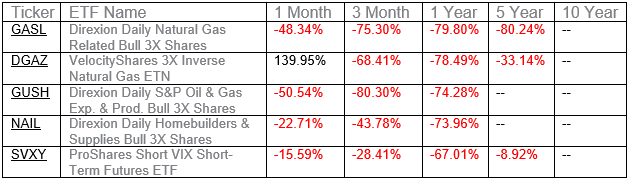
The following table shows the performance of the worst five ETFs in 2018, as well as their performance over the last month, the last three months, the last five and ten years.

Worst Performing ETFs 2018

The following table shows the performance of the worst five Non-Leveraged ETFs in 2018, as well as their performance over the last month, the last three months, the last five and ten years. Continue reading "Worst Performing ETFs Of 2018"