Sometimes Keeping it Simple is the Best Way To Invest

Matt Thalman - INO.com Contributor - ETFs


Now that 2014 is officially over, it is a good time to review your portfolio's performance. Whether you are a stock picker, day trader, mutual fund investor, commodities or currency guru; understanding how much you made or lost in the markets during the year is extremely important. But, just knowing whether or not you made money isn't enough; you need to know whether or not you outperformed the market itself or else all the time and money you spent researching, buy and selling, or paying an advisor was simply a waste.

In order to determine whether your complicating things and throwing money away you should be comparing your total portfolio returns to that of a specific index such as the S&P 500 or more specifically the SPDR S&P 500 ETF (SPY). By using the SPDR S&P 500 ETF as a benchmark, you can determine whether you beat or were beaten by the market. This information will then allow you to make a better financial decision about how and with whom you invest your money moving forward.

Let's get started

First let's start with how your portfolio performed? To get total portfolio return you need to calculate if your investments increased or decreased. Take all the individual stocks, bonds, mutual funds ETF's you own, add up the total value of the investments at the start of 2014 and subtract that by what they were worth at the end of the year. (That figure should include all dividends, capital gains from investments sold.) For example, if you started with $90,000 in investable assets on January 1, 2014 and on December 31, 2014 those assets were worth $104,500. Therefore the return would have been $14,500 for the year or a 16.1%.

Now compare that number with the SPDR S&P 500 ETF which rose 11.4% in 2014 pre-dividend or 13.27% with dividends calculated into the total return. The example above certainly would have beaten the SPDR S&P 500 ETF, meaning you didn’t waste time or money during 2014. Continue reading "Sometimes Keeping it Simple is the Best Way To Invest"

Ready Or Not, Copper Could Halve Its Value!

Aibek Burabayev - INO.com Contributor - Metals


Dear INO.com readers,

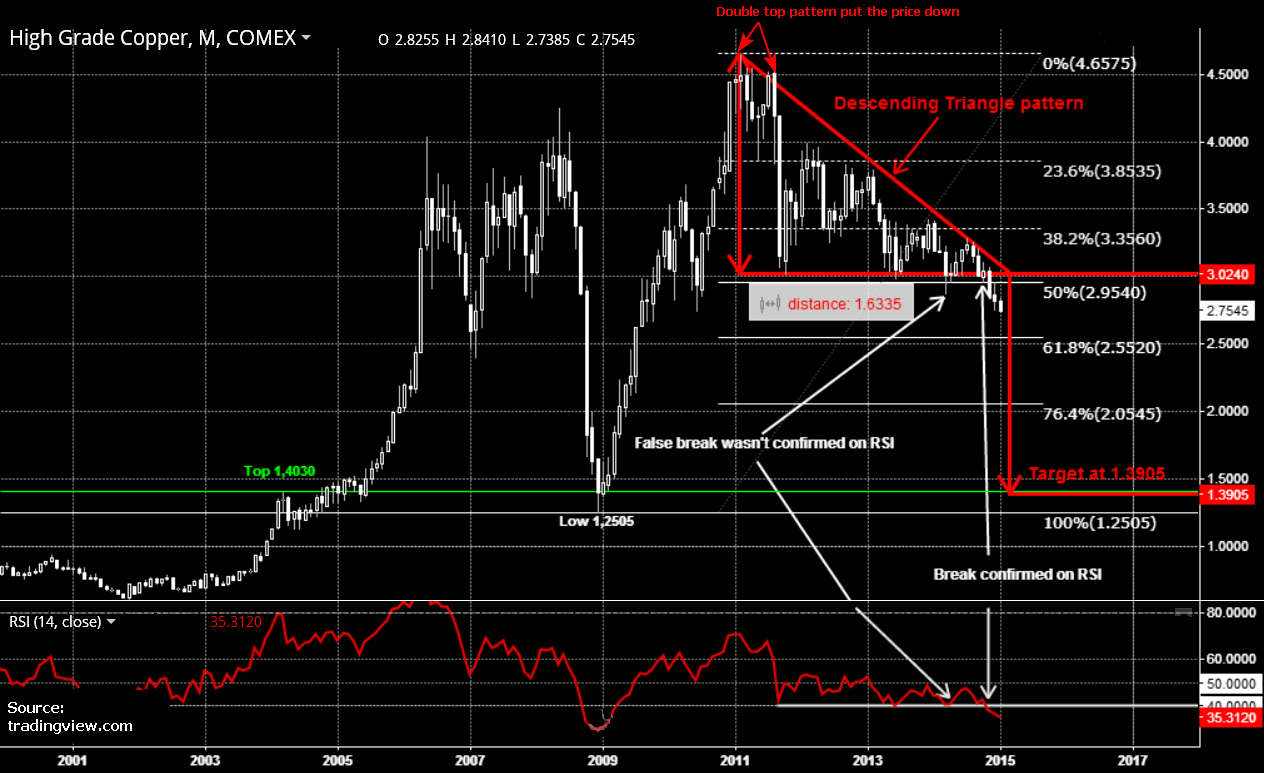
January turned out to be a harvest month for decent gain opportunities. This week, let's discuss copper which could lose half its weight this year. Impressive! Let's figure out how.

On the chart above, you'll see a monthly candle graph for COMEX high grade copper futures. As you can see, copper isn't phlegmatic at all, see-sawing up and down from below $1, up to almost $5 and again down for the past dozen years. And of course, that's why it is one of the best choices fo speculative traders.

2008 was a disastrous year for copper, free-falling from a $4.26 high to the $1.25 level and losing 70% of its value. Bad news for miners and brilliant for bear traders!

This reddish metal started 2009 as a rocket. Not to overload the graph, I didn't put Elliot waves on the bullish run. Two cycles completed on the way up from $1.25 to $4.55, where the fifth wave stalled with the top done at the $4.65 level at the start of 2011. 2.5 years of total growth thanks to QE. You should have noticed that fall is very short lived compared to unhurried growth, as fear is stronger than greed everywhere in the markets. Continue reading "Ready Or Not, Copper Could Halve Its Value!"

Last Week's Volatility Could Be A Harbinger Of Things To Come

There's a war going on right now and I don't mean overseas, I mean right here in the markets. Last week was a perfect example as the intraday swings of the S&P500 clocked in at a staggering 6.5%. Market volatility often is a precursor of things to come, and the irony of all this action was that the market closed with a loss of -0.65% for the week.

The net weekly change for the DOW was -0.53% and there was an even smaller loss of -0.42% for the NASDAQ. All three indices formed an important Japanese candlestick pattern, a weekly doji candle. Why is this important? A doji candlestick often signals indecision in the market. When the doji forms in an uptrend or downtrend, this is normally seen as significant, as it is a signal that the buyers are losing conviction when formed in an uptrend and a signal that sellers are losing conviction if seen in a downtrend.

What To Watch For This Week

A lower weekly close would indicate to me that the buyers are beginning lose control of this aging bull market. Here is the "line in the sand" for each of the indices that I am watching. Once below this line, watch for heavy liquidation to come in across the board.

DOW: 17.262
S&P500: 1,992
NASDAQ: 4.090

Gold Is Now Officially On The Move

You might remember on January 7th, I wrote a post on gold (FOREX:XAUUSDO) and the key neckline level. The key neckline in gold was broken to the upside last Friday when gold closed out the week with a very positive 2.9% gain. I now have a confirmed upside target zone of $1,340, which equates to about $132-$134 on the ETF, GLD. To follow all of the entry and exit points for gold, check in daily with the World Cup Portfolio. Continue reading "Last Week's Volatility Could Be A Harbinger Of Things To Come"

Play Defense With This Strategy In 2015


Over the holidays, I decided to drive to Orlando and give the Walt Disney Co. (NYSE: DIS) a few of my hard earned dollars. My 12 year-old son talked me into riding the Tower of Terror at Disney’s Hollywood Studios.

As a thrill ride, the Tower of Terror plays on three of humankind’s most basic fears: falling, the unknown and the dark. I wasn’t that concerned. In the investment biz, that’s just another day at the office.

But when it comes to the investing, I’ll be honest. I am a concerned about the stock market in 2015.

Here’s why: It’s all about earnings.

At the end of the day, an investor should buy a stock based on the underlying company’s ability to deliver quality, consistent earnings. Those earnings should also be purchased at a fair-to-discounted price as measured by a stock’s price-to-earnings ratio (PE).

In more bullish times, investors are sometimes a bit too optimistic about the future and will push stock prices and their attached PE’s higher. In bearish times, they often become too pessimistic and drive prices and PE’s down.

I took notice after working on this chart of peak PE ratios for the SP 500 Index.

The way the picture tells the story, we’re overly optimistic and at the same valuations as before the 2008-2009 crash.

So are we so positive? The current numbers don’t indicate a profoundly bullish market in 2015.

Consensus estimates for the SP 500's 2015 EPS are around $125. In 2014, the SP saw EPS at around $117.

If things go according to plan, the market would see EPS growth of about 6-to-7%. Curb your enthusiasm. Continue reading "Play Defense With This Strategy In 2015"

Practical Applications of Candlestick Charts

This audio lecture along with the downloadable PDF workbook covers and discusses practical trading approaches, including stop placement and trailing levels, risk parameters, money management and the psychology of trading any market with Japanese Candlesticks. The information derived by using this approach can directly influence the day-to-day decision process, which can enhance your awareness of the markets. You will learn the basics of Japanese Candlestick charting, as well as how to combine them with Western technical tools such as trend lines, DeMark Sequential, moving averages, stochastics, and may other standard technical tools.

Developed over three hundred years ago, this method of technical analysis is still relevant and an exceptional addition to Western technical analysis. By combining both approaches to market forecasting, one is able to take the best from both schools. Gary Wagner believes that the outcome from this combination is capable of extending the benefits of any methodology.

LISTEN NOW: Practical Applications of Candlestick Charts

Best,
The INOTV Team