Gold Futures Trade At Seven Year High

Gold Futures

Gold futures in the June contract settled last Friday in New York at 1,698 while currently trading at 1,740 up over $40 for the week continuing it's bullish momentum while still experiencing high volatility.

At the current time, I do not have any precious metal recommendations as I was stopped out of silver earlier in the week. However, if you are long a futures contract, I would place the stop loss under the April 21st low of 1,666 as an exit strategy as this is a very high-risk trade with large price swings that we experience daily. For the bullish momentum to continue, prices have to break the April 14th high of 1,788 in my opinion as we are witnessing a bullish trend as we are above the 20 and 100-day moving average. However, the problem with this market at the current time is that it has large sell-offs and then comes back every single time, but it has not been an easy trade to the upside even though we are trading at a 7-year high.

Economic stimulus continues to support prices as the U.S. government is putting trillions of dollars into the economy because of the Coronavirus situation as that is supportive towards the precious metals as trading this commodity should only be dealt with large trading accounts due to the risk.

TREND: HIGHER
CHART STRUCTURE: POOR
VOLATILITY: HIGH

Coffee Futures

Coffee futures in the July contract settled last Friday in New York at 117.55 while currently trading at 109.60 a pound down about 800 points for the trading week hitting a 5-week low as prices look to head back down to the 100 level in my opinion. Continue reading "Gold Futures Trade At Seven Year High"
The Financial Cohort and COVID-19 Destabilizing

COVID-19 ushered in the real possibility of widespread loan defaults, liquidity issues, ballooning credit card debt, and stressed mortgages. To exacerbate these COVID-19 realizations, a delicate balance between interest rates, Federal Reserve commentary, yield curve inversion, and concerns over a potential/scale of depression in late 2020 must be attained. The financial cohort is in a difficult space as the broader economic backdrop continues to dictate whether these stocks can appreciate higher. Ironically, in 2019 banks logged record share buybacks and increased dividend payouts stemming from successful stress tests. The initial shock of the COVID-19 pandemic resulted in the market capitalizations of many large banks to be cut by ~50%. Some of the largest banking institutions such as Citigroup (C), Goldman Sachs (GS), JPMorgan (JPM), and Bank of America (BAC) were sold off in the most aggressive manner since the Financial Crisis. At these depressed levels, are the banks investable in light of the COVID-19 backdrop?

Destabilizing Effects of COVID-19

COVID-19 has materialized into the black swan event that only comes along on the scale of decades. This COVID-19 induced sell-off has been the worst since the Great Depression in terms of breadth and velocity of the sell-off. This health crisis has crushed stocks and decimated entire industries such as airlines, casinos, travel, leisure, and retail with others in the crosshairs. The S&P 500, Nasdaq, and Dow Jones have shed approximately a third of their market capitalization, with the sell-offs coming in at 33%, 29%, and 36%, respectively, in late March. Some individual stocks have lost over 80% of their market capitalization and now run the risk of filing for bankruptcy.

The longer the COVID-19 economic shut down persists, the higher the unemployment will rise. More companies will run the risk of Continue reading "The Financial Cohort and COVID-19 Destabilizing"

Gold Could Fly Over A Helicopter Throwing Money

On the 16th of March, when I wondered if “That’s It?” for gold it dropped for more than $100 to the low of $1451. It looked like the first move down in the large second leg of a huge complex correction.

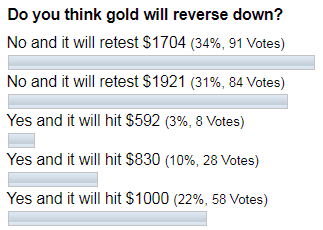
As we know, guessing tops and bottoms is a tricky exercise. So, the next move up was considered to be a correction as to confirm the top we should see the passing move down first (checked), then there should be a corrective move in the opposite (upside) direction and the next should be the continuation to the downside. Let’s see below if you thought gold would reverse down.

The majority of you remained bullish as you clicked on the “retest of $1704” and “$1921”. The first bet already paid well as the market retested the former top last Monday. This price move was quite sharp as previously the same distance unfolded by gold within only 82 daily bars from November 2019 till March 2020 compared to only 20 daily bars this time.

It looks like gold doesn’t want to drop as things changed dramatically. Continue reading "Gold Could Fly Over A Helicopter Throwing Money"

Is Real Estate The Next Shoe To Drop?

The past few weeks and months have been very interesting to see how the global central banks and governments have attempted to position themselves ahead of this COVID-19 virus event. We continue to suggest that we are just starting the process of navigating through this potentially destructive virus event. We believe the sudden onset of the virus pandemic has sent a shock-wave throughout the globe in terms of expectations and valuations that are, just now, starting to become “real”. Let us try to explain our thinking and how this relates to Real Estate.

The COVID-19 virus event is a global crisis event that is currently in the very early stages of consumer psychological processing. All types of crisis events prompt some forms of typical human reaction. We believe the Real Estate market may be the next big asset revaluation event as consumers continue to process the COVID-19 virus crisis and the consequences of this event.

Real Estate Cycles

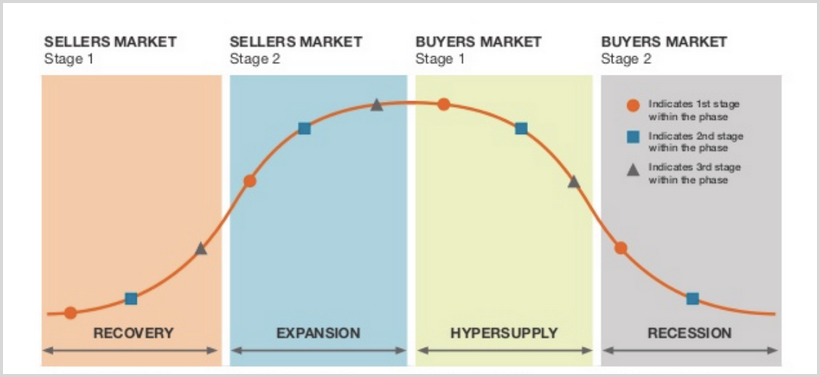
Real Estate cycles typically transition through the following phases as supply and demand functions work through the markets. Pay attention to the middle of this cycle chart. In the Expansion and HyperSupply stages, once supply peaks and prices somewhat peak/stabilize, a transition takes place in the market where buyers chase premium properties and push price levels moderately higher. The Recession Cycle is typically a disruptive cycle that is the result of an economic/income disruption. When people can’t earn enough to satisfy their debt obligations and or provide for their families, then the Real Estate cycle begins to contract.

Real Estate

An event like this, the COVID-19 virus event, would typically start out as a regional/local event. This did happen as it roiled certain areas of China in late 2019. Watching how China attempted to manage and hide the extent of the virus explosion within their country was painful to watch. Continue reading "Is Real Estate The Next Shoe To Drop?"

This Time It's For Real

A little over a year ago, I wrote a column about Modern Monetary Theory. Don't look now, but it's no longer a theory, it's reality. Depending on how it eventually turns out, we'll find out if the economic cure to the coronavirus was worse than the disease.

In simple terms, MMT adherents believe that countries that issue and back their currencies, like the U.S., can print as much money as they need and still stay solvent. (Compare the eurozone, where the European Central Bank issues the currency, not the individual member countries). And without creating runaway inflation.

You can try this at home, too, you know, although it doesn't work nearly as well for individuals as it does for governments. Pay off one of your credit card balances with a balance transfer from another bank, then keep repeating the process. This will work for a while until the merry-go-round eventually stops when the banks stop lending you money, and you'll have to either pay everything you owe or wind up in bankruptcy court.

Of course, it's different for the government, which is one of MMT's main arguments, since it can just print more money when it runs out, which means the merry-go-round keeps going, even if investors stop buying Treasury bonds. If that happens, which it never has, the Federal Reserve, a separate but "independent" arm of the government, will pick up the slack.

Neat, huh? Continue reading "This Time It's For Real"