CVS: Amazon Capitulates - Too Cheap To Ignore?

Noah Kiedrowski - INO.com Contributor - Biotech - CVS


Introduction

CVS Health Corporation (NYSE:CVS) recently touched down to a 52-week low of ~$60 per share which is a drastic decline from its all-time high of $112 in 2015 translating into a nearly 50% slide in its shape price. Its P/E ratio is in sub-10 territory against an S&P 500 average of 24, suggesting CVS is roughly 60% cheaper than the average stock. Its decline has unfolded in the face several headwinds that have negatively impacted its growth, and the changing marketplace conditions have plagued the stock. Starting in the latter half of 2015 and still unfortunately persisting, the political backdrop was a significant headwind for the entire pharmaceutical supply chain from drug manufacturers to pharmacies/pharmacy benefit managers (i.e. CVS and Walgreens (WBA)) and the drug wholesalers in-between (i.e. McKesson (MCK), Cardinal Health (CAH) and AmerisourceBergen (ABC)). As an extension of the political climate, the drug pricing debate has not subsided and continues to be a hot-button issue weighing on the overarching sector. In an effort to address these headwinds and restore growth CVS has made a bold $69 billion acquisition of Aetna (AET) to form a colossus bumper-to-bumper healthcare company. This new CVS will combine its existing pharmacy benefits manager (PBM) and retail pharmacies with the second largest diversified healthcare company. This is a bold and hefty price tag to pay yet may be necessary to compete in the increasingly competitive healthcare space in the face of drug pricing pressures. CVS is making a defensive yet essential acquisition moving into the future. As CVS transitions and realigns its business to adapt to the changing healthcare space along with Amazon’s (AMZN) competitive threat diminishing, I feel the stock is too cheap to ignore at these levels. Initiating a position near ~$60-$65 may be a substantial long-term investment for long-term value and appreciation.

Amazon’s Healthcare Capitulation

Amazon has officially entered the retail space via the Whole Foods acquisition. It had been rumored for months that Amazon was gearing up to gain entry in the potentially lucrative $560 billion prescription drug space by leveraging the Whole Foods storefronts. The speculation was rooted in Amazon’s ramped up hiring and talent acquisition to build an internal pharmacy benefits manager for its own employees. This internal effort was viewed as a proof-of-concept for the broader drug supply chain effort. Amazon has a health team that’s focused on both hardware and software projects, like developing health applications for the Echo and Dash Wand. Its cloud service, Amazon Web Services, continues to dominate the health, life sciences, and technology market as well. Amazon still has the potential with its technology and reach to disrupt the current marketplace however as of now Amazon has decided to not pursue this business in the near future. Continue reading "CVS: Amazon Capitulates - Too Cheap To Ignore?"

2018 U.S. Gasoline Season Outlook

Robert Boslego - INO.com Contributor - Energies - U.S. Gasoline


OPEC’s Monthly Oil Market Report (MOMR) for April featured an article on the summer petroleum products market. It observed that the U.S. is typically the key driver for products markets in the run-up to the summer driving season, and indicators are pointing to a positive and optimistic outlook.

It cites year-over-year January combined gasoline and diesel growth of 845,000 b/d. It states that the weekly data in February and March further supported this positive trend. And it concludes U.S. gasoline and distillates demand will grow by around a combined 992,000 b/d in 2018.

But a closer examination of gasoline demand and consumption estimates provide a different picture. Also, the MOMR totally ignored the supply side of the market, and last summer’s Hurricane Harvey and Mexico’s refinery problems contributed to support that is unlikely to be repeated this summer. Continue reading "2018 U.S. Gasoline Season Outlook"

Trump Tweets Create Opportunity for Investors

Matt Thalman - INO.com Contributor - ETFs


When Donald Trump goes to Twitter Inc. (TWTR) to voice his negative opinions, investors should begin trying to find opportunities. Over just the past few weeks we have seen two separate occasions in particular in which the President of the United States has directed negative tweets at specific industries or companies. In both cases, first with Amazon.com Inc. (AMZN) and more recently with The Organization of Petroleum Exporting Countries (OPEC), his tweets have sent asset prices lower for a short period, before they have recovered, opening up big opportunities for investors.

Amazon

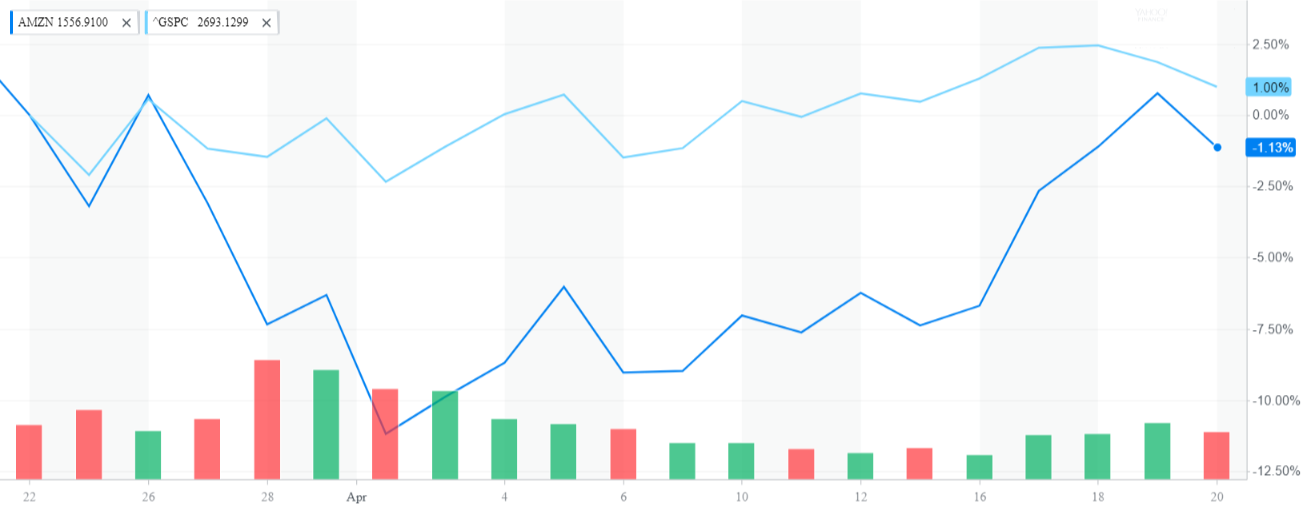
The end of March, beginning of April, Donald Trump assaulted Amazon with some tweets. First, it was that the company paid little to no state and local government taxes and then it was that the e-commerce company was a ‘scam’ which costs the US Post Office and therefore the American people, billions of dollars a year. Another string of tweets pointed the finger at Amazon claiming it was the reason thousands of retailers were going out of business, and millions of US workers had been laid off.

The tweets from Trump sent Amazon shares lower each day he would reignite his attack on the e-commerce giant. A 1-month chart of Amazon shows how the stock fell during the Presidents attacks and has since recovered.

Trump Tweets
From Yahoo Finance

Despite the fact that the President attacked Amazon and no real solution has come from the issues he pointed out, Amazon’s recovery appears to be nearly complete. This is not to say that the problems with Amazon not paying taxes or its contract with the Post Office couldn’t be reignited again in the future. But as most analysts have noted, the Presidents threats and claims against Amazon have no real teeth. Continue reading "Trump Tweets Create Opportunity for Investors"

Will The 10-year Treasury Crack 3% This Week?

George Yacik - INO.com Contributor - Fed & Interest Rates - 10-year Treasury


In case you hadn’t noticed, the yield on the benchmark 10-year U.S. Treasury note is this close to hitting the psychologically important 3% level. Is this the sign of still higher rates to come, or another buying opportunity, meaning rates are going to fall back again?

While most of the market seemed not to notice, seeing as it was fixated on corporate earnings and what’s going on in the tech sector, the yield on the T-note surged by 14 basis points last week to close Friday at 2.96%. That’s up nearly 25 bps since the beginning of this month and 55 bps year to date. It’s also the highest level since the beginning of 2014.

If you recall, we got close to hitting 3% two months ago, when the yield spiked to 2.95% on February 21, surging 25 bps in just two weeks before retreating quickly back to about 2.80% by the end of the month. The note then traded in a fairly narrow band between 2.80% and 2.90% over the next month before dropping sharply to 2.73% at the end of March and early April, after which it surged to Friday’s level.

Are we going to repeat the pattern of late February, meaning that this represents a buying opportuning in the Treasury market, or is this the signal that we are going to finally blow past 3% following February’s false start? Continue reading "Will The 10-year Treasury Crack 3% This Week?"

EUR/USD Update: Another Chance For Rally

Aibek Burabayev - INO.com Contributor - Metals - EUR/USD


Last month I shared with you a trade setup for a single currency against the Fiat King. There were two charts posted: one was showing the global map and the other one was dedicated to the short-term trade setup.

You could have booked around 1.9% or more than 200 pips by the end of the March of my earlier trade idea, where I recommended buying the euro on the dips below 1.23. The ultimate target was set according to the Fibonacci ratio projections between the $1.2647 and the $1.3139 per 1 Euro. The risk was limited below the $1.2150, and it was not materialized since then.

Indeed, the Euro dipped below $1.23 down to the $1.2240 area as planned. But on the move to the upside, it only advanced as high as $1.2477 on the 27th of March still gaining more than you could have risked. The EUR/USD couldn’t overcome the earlier top beyond $1.2556, and it retreated after that.

In this post, I updated the EUR/USD chart for you as the short-term chart structure has changed and it offers another trading opportunity. Continue reading "EUR/USD Update: Another Chance For Rally"