
McKesson Craters - Misses Q2 2017 Estimates and Lowers Guidance

Noah Kiedrowski - INO.com Contributor - Biotech


Overview

McKesson Corporation (NYSE:MCK) recently reported Q2 2017 numbers that missed analysts’ expectations on both EPS and revenue, missing by $0.11 per share and $1.25 billion, respectively. This was the fourth consecutive quarter in which McKesson has missed revenue targets. As a result of the most recent miss, shares of McKesson sank by ~$40 per share or 23% beginning in after-hours trading and through the next trading day (Figure 1). In February I wrote a piece on McKesson stating that I felt McKesson presented a buying opportunity when the stock sank to a 52-week low of $148 per share. As that call began to come to fruition, I wrote a series of follow-up articles voicing caution as the share price appreciated. On March 21st I framed my thesis as being well intact as the shares appreciated to the mid $150s. On May 29th I stated that concerns remained despite the solid Q4 2016 quarterly earnings as shares appreciated to the low $180s. On July 20th I stated that shares had appreciated 34% by reaching the ~$200 level and at that point, I was hesitant due to pressures regarding the pharmaceutical supply chain and earnings from other pharmaceutical wholesalers such as Cardinal Health. At the writing of the July 20th article, I had relinquished my position in McKesson due to the run-up in share price and the growing concerns of the business model in combination with social and political pressures.
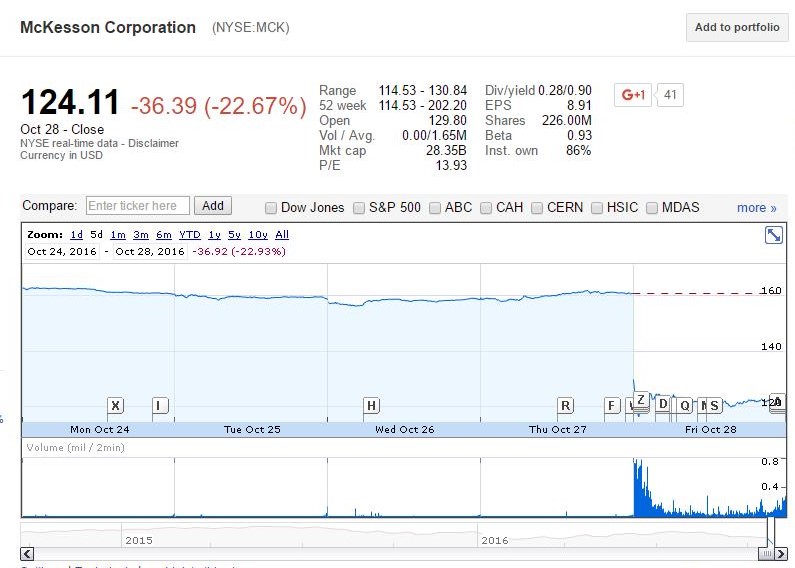
Chart of McKesson Corporation (NYSE:MCK)
Figure 1 – McKesson’s free fall after missing Q2 2017 earnings and lowering guidance

Continue reading "McKesson Craters - Misses Q2 2017 Estimates and Lowers Guidance"

Will China Drop The Ball?

Lior Alkalay - INO.com Contributor - Forex


Chinese policymakers are in the midst of a very delicate maneuver. With a hyped housing market and an unloved stock market, China’s policymakers want the “hot money” from real estate investment to be funneled away from housing and into the stock market. The problem? It won’t be easy and may require sacrificing economic growth, just at the point when growth has begun to stabilize.

The Bubble Returns

For some time now, Beijing has been well aware of the bubbly housing market. In fact, China has experienced two housing slumps in past decade, back in 2011-2012 and in 2014-2015, in both cases, the slump was largely due to the government’s efforts to curb prices in the preceding years. Those efforts were primarily through the implementation of new housing regulations and by clamping down on shadow lending. More importantly, the Chinese government put to good use its main monetary tool, the Yuan. By allowing the Yuan to strengthen, credit became more expensive and, as a result, the hype ended. But the price tag was dear because tightening efforts also resulted in a sharp slowdown in the Chinese economy and a meltdown in the Chinese stock market.

In 2015, the crisis was so severe, in fact, that Chinese policymakers had no choice but to drastically reverse policy by cutting lending rates, intervening in the stock market and, yes, as you might have surmised, devaluing the Yuan. But ironically, just when the easing measures have started to make a real impact, the housing market has once again become overheated and has turned bubbly. Continue reading "Will China Drop The Ball?"

GE's Timely Baker-Hughes Deal: Rigs And Oil Production Set To Rise

Robert Boslego - INO.com Contributor - Energies


General Electric Co. (NYSE:GE) announced a deal to combine its oil-and-gas business with Baker-Hughes, creating one of the world's largest providers of equipment, technology, and services to the oil and gas industry. Worldwide drilling activity had peaked in November 2014, the same month that Saudi Arabia had started the war for market share, which eventually caused oil prices to collapse.

As oil prices plummeted, so did the rig count. Active rigs worldwide fell from 3,670 to 1,405 in May 2016, a 62% drop. In the U.S., rigs fell from 1,930 t0 408, a 79% drop.

But as oil prices rebounded to $50/b in late May, the rout ended. Since May, active rigs rose by 25% in the U.S. and by 13% worldwide. Continue reading "GE's Timely Baker-Hughes Deal: Rigs And Oil Production Set To Rise"

Sterling Close To A Turnaround?

Lior Alkalay - INO.com Contributor - Forex


Ever since the surprise leave vote in the UK, investors have braced for a financial tsunami that could overwhelm the UK economy. Thus far, there has only been one real casualty—the Pound Sterling. All the while, the UK economy has surprised forecasters. The UK Manufacturing PMI already bounced back to an impressive 55.4; retail sales were surprisingly resilient and, most puzzling to economists, UK 3rd quarter GDP grew at a healthy clip of 2.3% Q3 year-over-year. So, what is really going on? Continue reading "Sterling Close To A Turnaround?"

Pendulum Experiment No.2 Snapshot: The Majority Is Wrong So Far!

Aibek Burabayev - INO.com Contributor - Metals


At the start of July, I reviewed the result of the first Pendulum experiment where the loser metal Palladium could beat the supercharged Japanese Nikkei stock index. The same day at the end of the post I proposed to push the Pendulum again. This time we entered into competition the faded Nikkei index versus the matchless metal silver. Below is the graph of the bets you placed.

Chart 1. Nikkei Vs. Silver: Voting Results:

INO.com Poll

This vote clearly shows the biases of the readers as in the second experiment like in a first one the odds were in favor of the metal, at the first time it was palladium and this time it was silver. Only one person added to my voice in favor of the Nikkei as I am acting as an experimenter and chose the success of the Pendulum effect betting on the stock index to break the shutout.

Well, you will be surprised looking at the chart below as the majority’s bet is wrong so far. Continue reading "Pendulum Experiment No.2 Snapshot: The Majority Is Wrong So Far!"