World Oil Supply And Price Outlook - September 2020

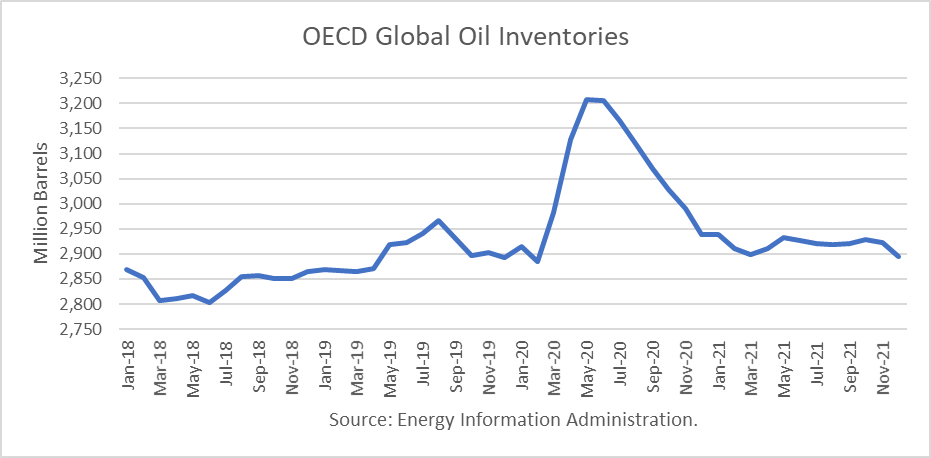
The Energy Information Administration released its Short-Term Energy Outlook for September, and it shows that OECD oil inventories likely bottomed in this cycle in June 2018 at 2.804 billion barrels. It estimated stocks dropped by 45 million barrels in August to end at 3.120 billion, 179 million barrels higher than a year ago. It estimates that inventories peaked in May 2020 at 3.209 billion.

The EIA estimated global oil production at 91.55 million barrels per day (mmbd) for August, compared to global oil consumption of 94.31 mmbd. That implies an undersupply of 2.76 mmbd or 85 million barrels for the month. About 32 million barrels of the draw for August is attributable to non-OECD stocks.

For 2020, OECD inventories are now projected to build by a net 46 million barrels to 2.939 billion. For 2021 it forecasts that stocks will draw by 44 million barrels to end the year at 2.895 billion.

Oil

The EIA forecast was made incorporates the OPEC+ decision to cut production and exports. According to OPEC’s press release: Continue reading "World Oil Supply And Price Outlook - September 2020"

Options - 35% Option-Based Portfolio Return

A total of 99 option trades were executed in May, June, July, and August as the markets reached an inflection point and rebounded after the COVID-19 lows. During this timeframe, all 99 trades were winning trades to lock-in a 100% option win rate with an average income per trade of $180 and an average return on investment (ROI) per trade of 7.4%. After the tumultuous market lows of March and into early April, leveraging a minimal amount of capital, mitigating risk, and maximizing returns are essential. An option-based portfolio can offer the optimal balance between risk and reward while providing a margin of downside protection with high probability win rates. As the market continues to rebound, optimal risk management is essential when engaging in options trading as a means to drive portfolio performance.

Through the end of August, an option-based portfolio broken out into roughly three parts of ~40% cash, ~30% long equity, and 30% options matched the S&P 500 performance, posting returns of 35.1% and 35.4%, respectively. Risk mitigation needs to be built into each trade via risk-defining trades, staggering options expiration dates, trading across a wide array of uncorrelated tickers, maximizing the number of trades, appropriate position allocation, and selling options to collect the premium income. Maintaining disciple via continuing to risk-define trades, leveraging small amounts of capital while maximizing return on investment, is essential despite the impressive streak of 80 consecutive winning trades.

Option-Based Portfolio/Long Equity Boost

Anchoring down an option-based portfolio is a key component to taking advantage of black swan events such as COVID-19 via broad-based ETF exposure. During the market lows of March/April, the cash-on-hand component of an option-based portfolio was used to go long equity via Dow Jones (DIA), S&P 500 (SPY), and Nasdaq (QQQ). The cash-on-hand was repurposed to balance out the portfolio into roughly three equal parts of one-third cash, one-third long ETF based equity, and one-third options driven. Through the end of August, an option-based portfolio matched the performance of the S&P 500, posting returns of 35.1% and 35.4%, respectively (Figure 1). Continue reading "Options - 35% Option-Based Portfolio Return"

What's Next For The Dollar, Gold And Silver?

We have an interesting situation in the market as the strength of inversely correlated instrument didn’t push the other asset price down. Such things happen, and I showed you in the past that the correlation itself is not a dogma. The market flows are driven by investors’ sentiment, which in turn is based on subjective judging.

Let’s see the updated charts below, and the US dollar index (DXY) will be the first.

Dollar

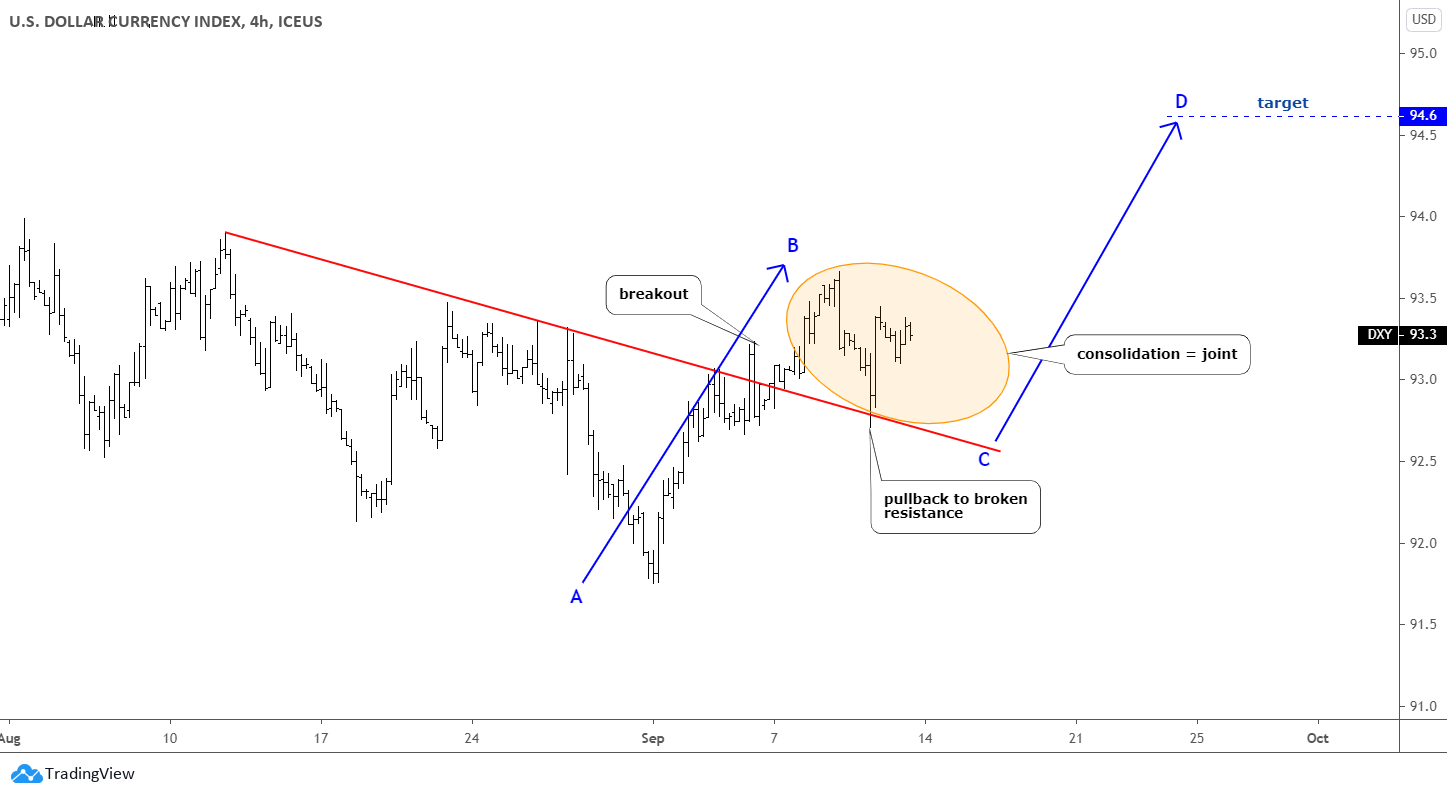
The votes under my previous post about the next move for DXY were split evenly between “break up” and “another drop” options. It’s quite a natural outcome as we never know for sure if a breakout would happen or not. The extreme bullish divergence on the daily RSI finally enforced the price to break up the red resistance. Continue reading "What's Next For The Dollar, Gold And Silver?"

High Volatility Hits Futures Market

Copper Futures

Copper futures in the December contract settled last Friday in New York at 3.0620 a pound while currently trading at 3.0370, down about 250 points on high volatility as prices are still hovering right near a 2 year high.

If you take a look at the daily chart, the uptrend line remains intact coupled with the fact that prices are trading above their 20 and 100-day moving average as this trend is strong to the upside even though prices have stalled out over the last couple of weeks.

I have been recommending a bullish position from around the 3.0140 level. If you took that trade, continue to place the stop loss under the 2 week low on a closing basis only at 2.9535 as an exit strategy chart structure is outstanding. For the bullish momentum to continue, prices have to break the September 1st high of 3.0945, in my opinion. I still believe the risk/reward is in your favor for a bullish position as this commodity at the current time is following the stock market, which has showed some high volatility to the downside over the last several days, keeping a lid on prices.

TREND: HIGHER
CHART STRUCTURE: POOR
VOLATILITY: HIGH

Silver Futures

Silver futures in the December contract settled last Friday in New York at 26.71 an ounce while currently trading at 26.92, up slightly for the trading week as prices continue their sideways trading action. Continue reading "High Volatility Hits Futures Market"

The Fed Makes It Official

The Fed recently enacted what the experts are calling a historic policy change. More accurately, it’s the official acknowledgment of what the Fed has already been doing, namely keeping interest low, seemingly forever. What it also means is that it sharply alters the old 60-40 investment mix, to something more like 80-20 or 80-10-10.

The Fed is basically assuming that inflation will be nonexistent – or, at least manageable – for the foreseeable future and is, therefore, willing to let it run “hotter” for longer than it used to before it steps in and raises interest rates. But is that a realistic assumption? Nearly unanimously, Fed officials have been touting the party line that the economy is bad – despite numerous reports that show it is snapping back pretty strongly – and is likely to stay that way or get even worse – which may not be the case. The stock market certainly doesn’t seem to be buying that.

What the Fed seems to be doing is baking in the cake its already oversized role in the economy (and society) and keeping it that way “for as far as the eye can see.”

As I noted in my previous column, cynics might draw the conclusion that the Fed is purposely dumbing down its economic forecasts so as to cement its role for the long-term. Jerome Powell’s streamed announcement at the Jackson Hole summit pretty much made that de facto.

So what does that do for your portfolio? Given that the Fed has now determined that rates will stay low for the foreseeable future, do bonds have any place in your portfolio? What would be the point? Continue reading "The Fed Makes It Official"