Another Big Cyber-Security Hack, When Should You Buy The HACK ETF

Matt Thalman - INO.com Contributor - ETFs


The world of Exchange Traded Funds is massive and growing every day. Whether it’s a simple index fund to a specialty fund that focuses on a very niche industry, you can most likely find an ETF that is right for you. I often tout the S&P 500 index funds for their low cost and how easy they are for a non-financial savvy investor to get into the market and start investing.

But, for those who have a solid understanding of the markets, the risks, and enjoy finding new investments, I love highlighting the niche ETF's I find. One of my favorite specialty ETF's is the PureFunds ISE Cyber Security ETF (HACK). HACK tracks an equal-weighted index of companies that are actively involved in the cyber security industry.

With the recent global hack that locked users out of their computers and demanded a ransom be paid, the HACK ETF received little attention, while the companies it owns received a lot. That attack once again highlighted the importance of cyber-security and how cyber-attacks are here to stay and will only likely become more prevalent with time. Continue reading "Another Big Cyber-Security Hack, When Should You Buy The HACK ETF"


Stock Analysis From A To Z: Starting With The Letter "A"

Aibek Burabayev - INO.com Contributor - Metals


Earlier in the year, I had asked you to post things that you would be interested in me analyzing, and to my amazement, many of you asked for stocks. While that is outside my normal scope of the markets, I believe that my technical analysis could prove beneficial. So, with that in mind, I will start to share some technical analysis of U.S. stocks.

To keep it interesting, I plan on cycling through the stock market in alphabetical order using the criteria below.

Of course, I will continue to analyze the precious metals market, and that will still be my primary focus. Continue reading "Stock Analysis From A To Z: Starting With The Letter "A""

Why The U.S. Gasoline Stock Build Was Not Surprising

Robert Boslego - INO.com Contributor - Energies


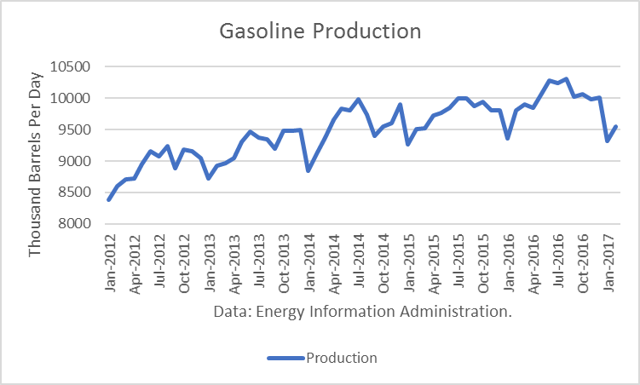
The Energy Information Administration (EIA) reported that gasoline stocks had “surprisingly surged despite heavy driving on the Memorial Day weekend.” But the 3.3 million barrel build was actually not that surprising, given the development of gasoline production capacity and the relative softness of gasoline demand.

Over the past four years, the U.S. refining industry expanded its gasoline production capacity in the United States by almost one million barrels per day. In 2013, production peaked at just below 9.5 million barrels per day. Last year, production peaked at 10.3 million. And this summer production could reach 10.5 million.

Gasoline Production

Gasoline demand growth has lagged. Peak demand in 2013 was just above 9.1 million. Last summer, demand peaked at 9.6 million, an increase of about one-half million.

But in the year-to-date, gasoline demand has been 2.9% lower than over the same weeks in 2016. Retail gasoline prices dropped to low levels in the first quarter of 2016, when crude oil prices were bottoming, and that created a surge in demand that was not repeated in 2017. Continue reading "Why The U.S. Gasoline Stock Build Was Not Surprising"

Quadruple Leveraged ETF Approved and I Am Terrified

Matt Thalman - INO.com Contributor - ETFs


At the beginning of May 2017 the wise, an all knowing Securities & Exchange Commission approved a new leveraged Exchange Traded Fund. While SEC approvals for new funds don’t often make headlines, the reason this was did because of the amount of leverage the new ETF offers and what it means for the future of investing.

On May 2, 2017, the SEC approved the ForceShares Daily 4x US Markets Futures Long Fund which will have the ticker "UP" and the ForceShares Daily 4x US Markets Futures Short Fund which will have the ticker "DOWN."

Yes, you did read that correctly, these are 4X funds which will deliver 400% the daily performance of the S&P 500. Previously investors had access to 3X funds, which offered 300% the daily moves of the indexes they track, but with this move, 400% may now seem to be the benchmark. Continue reading "Quadruple Leveraged ETF Approved and I Am Terrified"

AbbVie Put/Call Combination Produces 400% Greater Return

Introduction and Set-Up

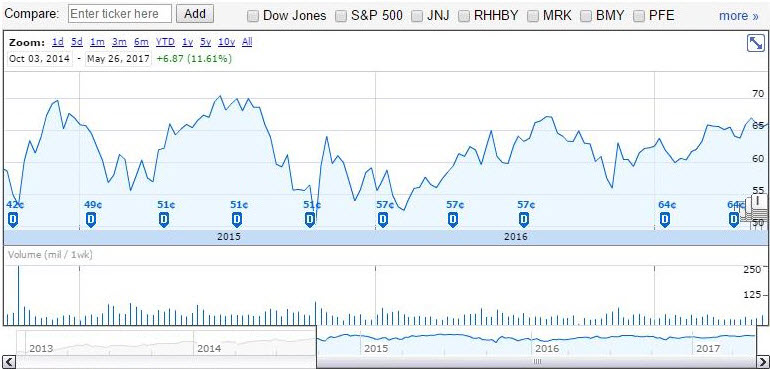
Below I’ll discuss my year-long call/put combination using AbbVie as an example. I’ve successfully been able to obtain a 15.3% return based on the current stock price while the buy and hold strategy would've only yielded 3.6% return. This is greater than a 400% difference in overall returns for this given stock over the past year. Leveraging the coupling of calls and puts around a core position over time can accentuate total returns and mitigate risk on a given stock. As discussed in more detail below, covered calls and covered puts can be combined to one's advantage. This is especially true in large-cap, dividend-paying stocks that tend to trade within a narrow range for long periods of time. AbbVie Inc. (NYSE:ABBV) is a prime example that fits this narrative and thus the stock of choice for this piece. Over the past two-plus years this stock has traded in a tight range between $55 and $65 per share while paying a dividend of ~4% on an annual basis (Figure 1). The company has strong fundamentals, financial stability and a robust pipeline for potential growth and sustainability. The goal here to initiate a position in AbbVie using a covered put to purchase the stock at a lower price than it's currently trading at a future date while collecting a premium in the process. If the stock isn't assigned then walk away with the premium and freed up cash that was earmarked for the potential purchase. If the stock is assigned, then shares are purchased at the agreed-upon price (strike price), less the premium for the actual purchase price. Now we've entered the position via leveraging a covered put, now the shares can be leveraged for covered calls to extract additional value throughout the holding of the stock while collecting the dividend. Ideally, we want to enter the position via a covered put and endlessly sell covered calls while collecting the dividend. However if the stock is called away during the selling of a covered call then this process can be repeated while being cognizant of the x-dividend dates to enhance overall returns.

Chart of AbbVie Inc. (NYSE:ABBV)
Figure 1 – AbbVie’s tight trading range over the past 2-plus years
Continue reading "AbbVie Put/Call Combination Produces 400% Greater Return"