The Fed Giveth, The Fed Taketh Away

With the stock market tanking and the Federal Reserve finally starting to raise interest rates and reduce its $9 trillion balance sheet, it's probably a good time to look back and determine how much of the stock market's gains in the past 12 years or so have been built on extremely accommodative Fed monetary policy. That could provide some idea of how much we can expect the market to drop once the Fed has finally stopped the tightening process, and when stocks might start rising again.

Since reaching its all-time high of 16,057 back on November 15, the NASDAQ had dropped nearly 29% as of May 18, when it closed at 11,418. Likewise, the S&P 500 is down nearly 18% since it hit its all-time high on December 27, while the Dow is off more than 13% after reaching its peak on that same day.

Those declines followed several indications from Fed Chair Jerome Powell and other Fed officials that the central bank had finally conceded that inflation wasn't "transitory" after all and that it had to act aggressively before inflation got totally out of control.

The Fed raised its benchmark interest rate by 25 basis points on March 16, its first rate increase since December 2018, and another 50 bps on May 4, its largest increase since May 2000. The Fed's next meeting is scheduled for the middle of next month, at which it is expected to vote for another 50-bp hike, followed by several more by the end of the year. If the Fed raises rates by 50 bps at each of its next five meetings, including the one right before Election Day, that will push its benchmark rate to Continue reading "The Fed Giveth, The Fed Taketh Away"
3 Gold Miners To Inflation-Proof Your Portfolio

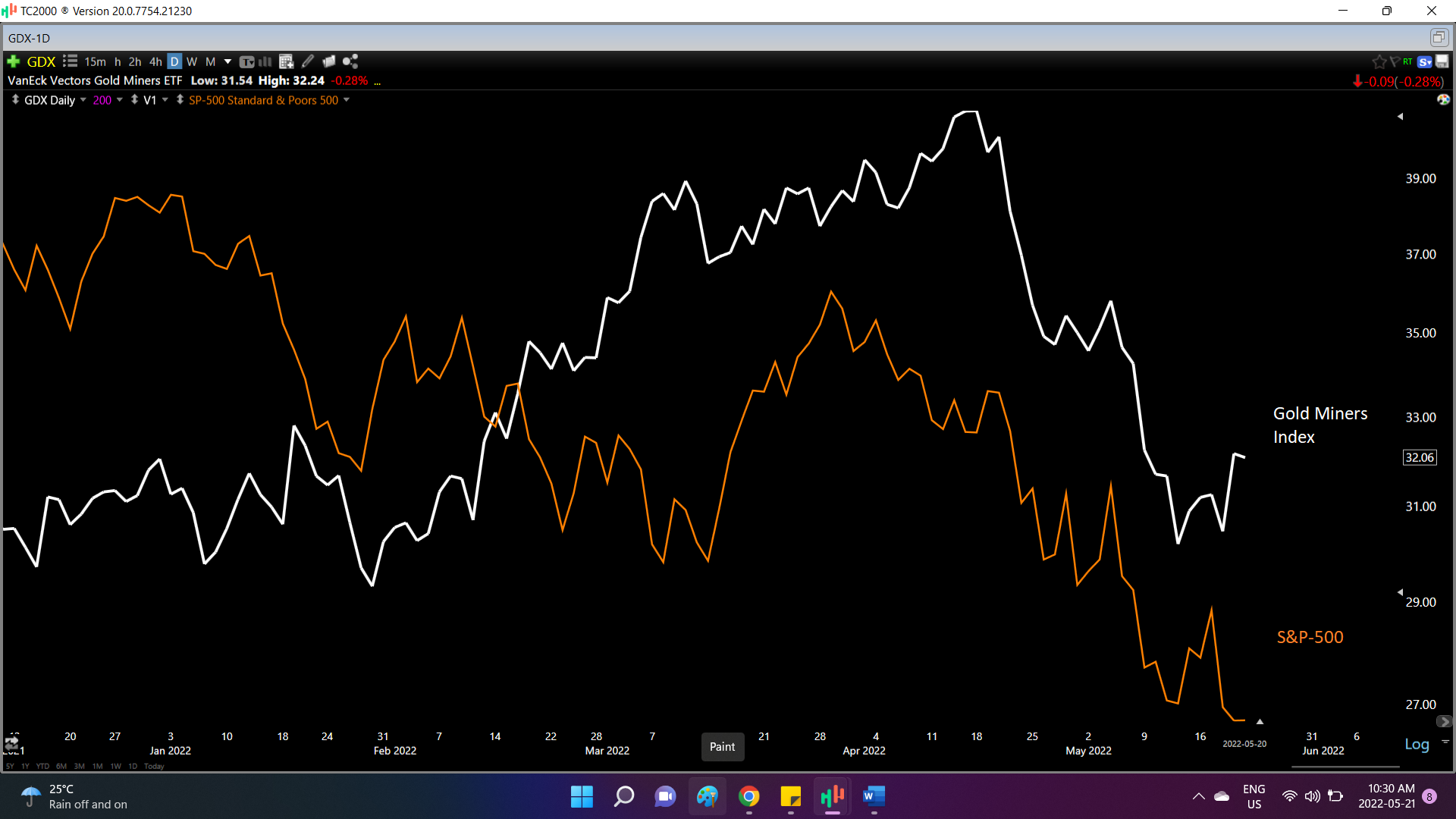
It was another turbulent week for the major averages, with the S&P 500 (SPY) finding itself down 3%, extending its decline to the 20% mark. However, one sanctuary from the turbulence was the Gold Miners Index (GDX). Not only did the index not lose ground last week, but it gained 3%, and it is one of the few ETFs sporting a year-to-date gain. This continued relative strength combined with an undervalued industry group relative to historical levels suggests that this is a group worth keeping a close eye on for investors looking to inflation-proof their portfolios.

Gold Miners Index (GDX)

Source: TC2000.com

With inflation readings continuing to sit at multi-decade highs and the Federal Reserve maintaining its hawkish pivot, there are few places to hide in today's market. However, one asset that has historically done well in periods of negative real rates is gold (GLD), and one way to collect income with exposure to the gold price is through gold miners. The caveat, however, is that they must be trading at a deep discount to net asset value [NAV] and ideally out of favor. With more than 80% of miners trading at discounts to NAV and the industry group down nearly 40% from its Q3 2020 highs, it currently meets both requirements. Let's look at three names that make for solid buy-the-dip candidates: Continue reading "3 Gold Miners To Inflation-Proof Your Portfolio"

Gold Update: Window Of Opportunity Still Open

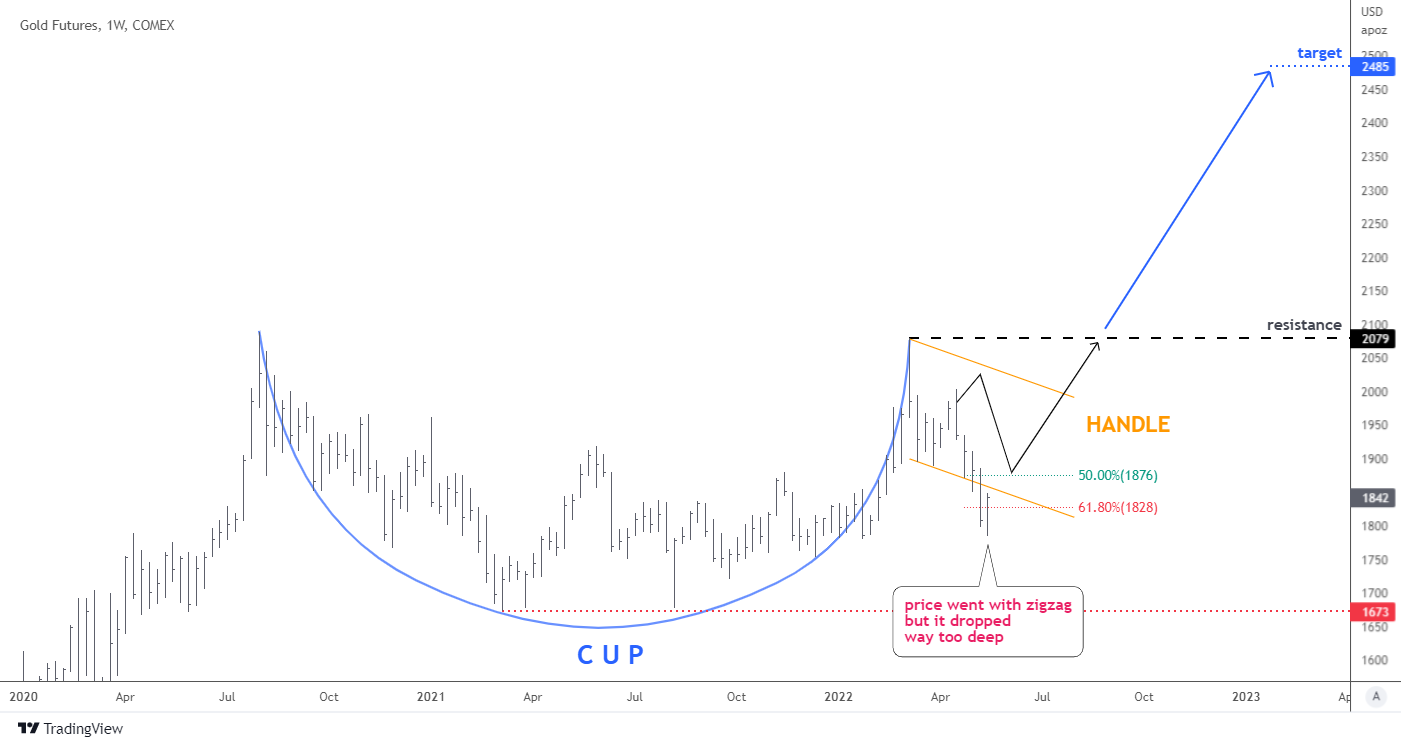
Last month I spotted a “Repeated Bullish pattern” of another Cup & Handle model.

The majority of readers confirmed that they see it either. Most of you supported my outlook of an extended Handle with another zigzag to the downside. This was the right guess. Let me show it to you in an updated chart below.

Weekly Gold Chart

Indeed, the gold futures price followed the black zigzag on the chart to the downside. Hence, the outlook played out as planned. However, the depth of the drop was excessive as it hit below the expected valley of 50% Fibonacci retracement level and even 61.8%. The collapse stopped only close to four-fifths of the Cup. The classic approach would invalidate the pattern in this case. Continue reading "Gold Update: Window Of Opportunity Still Open"

What All The Recession Talk Really Means

If you’ve been following along here over the past year, I won’t have to remind you that I have no problem telling it just like it is. And that includes the good news, and the bad news, about Bitcoin (BTC), cryptocurrencies in general, stocks, and the economy. You name it, and I try to be upfront and transparent.

In fact, in last week’s post, I gave you the grisly details behind the sell-off in just about every asset class. I showed you how much every major stock index was down for the year in gory detail. I then showed you how Bitcoin was a member of that dubious club.

I also got under the hood of what I consider to be the biggest factor right now, which is hammering stocks and Bitcoin: Inflation.

The fact is inflation is at nosebleed levels, and it’s got just about everyone in a tizzy. And with good reason: Inflation eats away at incomes and makes products and services super-expensive. And since inflation now stands at multiple decade highs, you ignore it only at your own peril.

But as bad as inflation is, I have to remind you that down deep, what really makes investors nervous is not inflation itself but the tool of choice that gets used to fight it: Higher interest rates. Continue reading "What All The Recession Talk Really Means"

Money Apparently Can Buy Happiness

A recently published paper by Matthew Killingsworth, a senior psychology fellow at The Wharton School of Business at the University of Pennsylvania, concludes that individuals with higher income often reported increased levels of day-to-day happiness and overall life fulfillment.

Previous research done at Princeton University found that happiness sort of plateaued once annual income reached around $75,000 per year. But Killingsworth believes that to be false and thinks the correlation between happiness and income can move higher in tandem indefinitely. He doesn't think that money and happiness are mutually exclusive. However, he does feel that people with higher incomes often feel they have more control over their lives.

The thinking is that the more money you make, the more choices you available to you during your everyday life. For example, it could be something as small as whether or not you buy organic food. Maybe a little bigger such as your range of 'affordable' cars becomes larger. Your living situation changes because you can afford a home or rent closer to where you work, thus reducing your commute. Killingsworth goes on to point out things like someone quitting a job or even ending a relationship, two things that may become 'easier' if your income is higher.

Obviously, not everyone that responded to the survey questions from Killingsworth reported higher happiness with higher incomes. Still, those who said financial security was important to them overwhelmingly showed a correlation to higher happiness with higher levels of income. However, Killingsworth also pointed out that some individuals with very low levels of income report high levels of happiness. He concludes that more money does buy happiness, but money is not the secret to happiness. Continue reading "Money Apparently Can Buy Happiness"