Covered Puts: An Alternative To Buy and Hold

Options can provide an alternative approach to the traditional buy and hold for the long-term strategy. Options can add value to one’s portfolio in a variety of ways, specifically, maintaining liquidity via maintaining cash to engage in covered put options, initiating positions via being assigned shares strategically prior to or upon expiration of the option contract and capturing premium income via closing out the contract prior to expiration as the shares move in your favor to realize income. Here, I’ll discuss these three different scenarios and strategies behind each one with real life examples.

Maintaining Liquidity and Capturing Premium Income

Maintaining liquidity is integral to any portfolio as cash can be deployed in opportunistic scenarios to capitalize on sell-offs or adding to a long position that has corrected to lower cost basis. Covered puts can be implemented as a means to leverage cash on hand to sell contracts that are covered by cash. This cash would be deployed in an effort to maintain this cash balance yet be put to work via an option contract. This cash reserve can be utilized for selling covered puts thus not purchasing the underlying security with the end goal of never being assigned shares and netting premium income in the process. Once the contract expires, the covered cash allocated to the contract will be freed in addition to the cash that was realized from the option premium at expiration. This scenario will allow cash reserves to be maintained while adding cash via covered put contracts. Continue reading "Covered Puts: An Alternative To Buy and Hold"

Facebook's Decline Has Hurt These ETFs

Matt Thalman - INO.com Contributor - ETFs - Facebook


When a major company such as Facebook Inc. (NASDAQ:FB) is caught in a scandal, the declining share price doesn’t just hurt investors who knowingly bought shares of the company. It also hurts all those unsuspecting shareholders who may own part of the company through different Exchange Traded Funds.

On March 16th, shares of Facebook were trading at $185.09. The news broke that 50 million customers had their data taken from Facebook by a company called Cambridge Analytica and used to persuade American’s to vote for President Donald Trump. By March 27th Facebook shares had bottomed out at $152, a nearly 18% decline from the day before the story broke. As of this writing, shares of the social media giant have recovered a little, and now they trade at $160 per share, still a 13.5% decline.

Anyone that knowingly owned shares of Facebook before this story breaking has decided to either ride this rough patch out or jumped ship. But, some investors own shares of Facebook and have likely taken a beating because of the situation and may not even have known what was causing their portfolios to fall. Continue reading "Facebook's Decline Has Hurt These ETFs"

Sales Jump 85% For Cannabis Security Company

Analysis originally distributed on March 28, 2018 By: Michael Vodicka of Cannabis Stock Trades

Due to restrictive federal banking regulations, cannabis dispensaries are known to operate with large amounts of cash.

Copious amounts of cash have attracted criminal activity to the industry.

For example, in 2016 a security guard at a Colorado dispensary was killed.

In late summer 2017, a cannabis dispensary in San Fransisco was robbed of $600,000 in cannabis products.

Police say these kind of robberies are becoming more common.

If you poke around on the Internet, you will find hundreds of stories about criminals targeting cannabis dispensaries for cash and product.

Until the US cannabis industry is free from these restrictive federal banking regulations, cannabis dispensaries remain as hot targets for criminals.

While this is a speed bump in the long-term growth potential of the US cannabis industry, it's also creating a significant opportunity for a former military security specialist and his promising security company.

This little-known security company: Continue reading "Sales Jump 85% For Cannabis Security Company"

China Retaliates By Slapping Tariffs On U.S.

Hello traders everywhere. Fear of a trade war between China and the U.S. has returned to the stock market Wednesday, hitting U.S. stocks hard at the open and sending investors into haven assets from gold to Treasuries.

The DOW opened considerably lower and headed down as much as 510 pts before bouncing off the lows in early trading and looks to have settled around the 1% loss territory mid-day. We'll have to keep a close eye on the close today to see if there's any follow through from the harsh open.

Tariffs

China and the United States both announced tariffs on $50 billion of each others' imports. But, while Washington's list covers many obscure industrial items, Beijing's covers 106 essential U.S. imports including soybeans, planes, cars, and chemicals.

The speed with which the trade struggle between the two countries is ratcheting up is blinding. China took less than 11 hours to respond with its measures.

Key Levels To Watch This Week:

Continue reading "China Retaliates By Slapping Tariffs On U.S."

Analysis Of The EIA Crude Oil Statistics

Robert Boslego - INO.com Contributor - Energies - Crude Oil Statistics


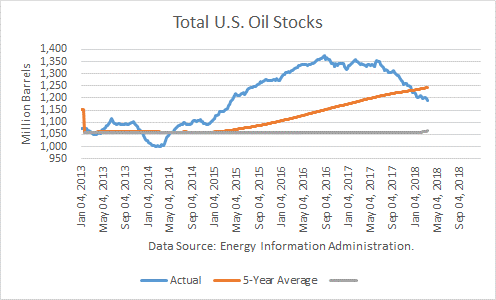
According to the Energy Information Administration (EIA), U.S. petroleum inventories (excluding SPR) fell by 6.9 million barrels (mmb) last week. They stand about 52 mmb lower than the rising, rolling 5-year average and are about 149 mmb lower than a year ago. However, comparing total inventories to the pre-glut average (end-2014), stocks are 127 mmb above that average.

Crude Oil Statistics

Commercial crude stocks fell by 2.6 mmb, and SPR stocks were unchanged last week. Gasoline stocks fell by 1.7 mmb, and distillate stocks fell 2.0 mmb. Primary demand dropped 256,000 b/d to average 20.675 million barrels per day (mmbd). Continue reading "Analysis Of The EIA Crude Oil Statistics"