3 Reasons Why You Should Still Avoid MJ, The Marijuana ETF

2018 was a tough year for long-term buy and hold marijuana investors. As a whole, the industry went on quite a wild roller-coaster ride. Marijuana stocks popped in December 2017 as anticipation for the ‘legalization’ of the drug occurred in the state of California on January 1st, 2018. We saw stock prices and the ETFMG Alternative Harvest ETF (MJ) jump as investors anticipated a ‘boom’ for the industry.

But, within a month or so of the legalization date, most of the marijuana-related stocks have fallen in price and MJ was trading below its December 2017 price. A few months went by, and most of the industries stocks just meandered along. Then the next big ‘legalization’ date grew near, October 17th, 2018, the day marijuana became legal in Canada.

The price of most of the well known and many of the lesser-known marijuana stocks, and MJ of course, once again began to ski-rocket. MJ, for example, went from $24 per share in August 2018, to as high as $45 per share, with its peak occurring just days before October 17.

Each time a new State or large country legalizes the drug, the companies in the industry experience an unfound increase in their valuation as investors buy shares at an insanely high rate. This type irrational buying leading up to a hyped up, essentially arbitrary date has put a lot of investors in a really bad place in 2018. MJ for one is down more than 24% in 2018, while other individual marijuana companies have seen their stock prices fall even further. Continue reading "3 Reasons Why You Should Still Avoid MJ, The Marijuana ETF"
U.S. Crude Production Gains Slow In October

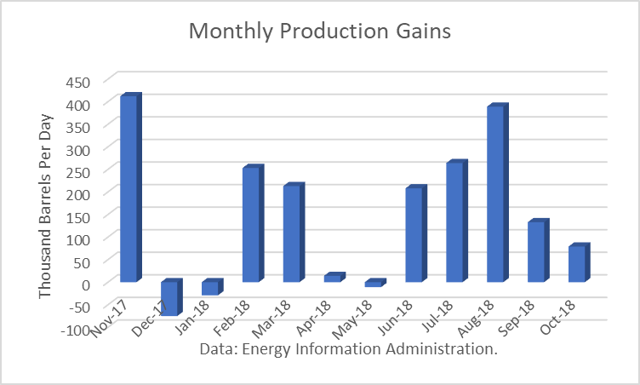
The Energy Information Administration reported that October crude production averaged 11.560 million barrels per day (mmbd), up 79,000 b/d from September. This was a slowdown in growth from the spectacular numbers recorded in July and August.

Crude Production

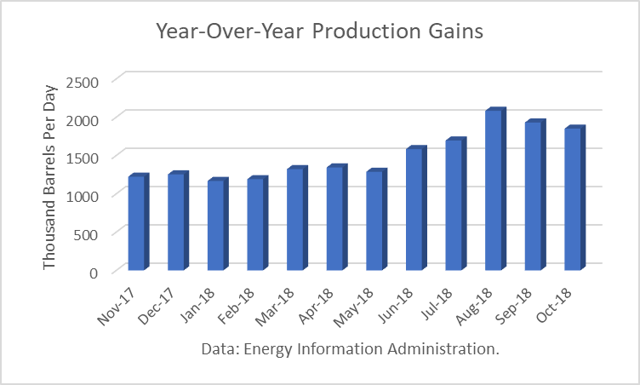
However, the year-over-year gain was still a very impressive 1.850 mmbd. And this number only includes crude oil. Other supplies (liquids) that are part of the petroleum supply add to that. For October, that additional gains is about 600,000 b/d.

Crude Production

The gain was led by a 33,000 b/d increase in New Mexico, a 31,000 b/d rise in North Dakota and a gain of 22,000 b/d in Colorado. Weather factors affected the overall gain, as production fell by another 29,000 b/d in the U.S. Gulf. Continue reading "U.S. Crude Production Gains Slow In October"

What's Next For Gold?

Early trading on January 4, 2019, saw Gold reach just above $1300 per ounce – confirming our price target from our research and posts on November 24, 2018. The importance of this move cannot be under-estimated. Traders and investors need to understand the recent rally in the metals markets are attempting to alert us that FEAR is starting to re-enter the market and that 2019 could start the year off with some extended volatility.

Our research has shown that Gold will likely rotate between $1270~1315 over the next 30~60 days before attempting to begin another rally. Our next upside price target is near $1500. We will continue to post articles to help everyone understand when and how this move will happen. We expect Gold to rotate near the $1300 level for at least another 30 days before attempting another price rally.

Pay attention to the Support Zone on this Daily Gold chart and understand that price rotation is very healthy for the metals markets at this point. A reprieve in this recent Gold rally would allow the start of 2019 to prompt a moderate rally in the US stock market as well as allow a continued capital shift to take place. As capital re-enters the global equities markets, investors will be seeking the best investment opportunities and safest environments for their capital. Our belief is that the US stock market will become the top-tier solution for many of these investments. Continue reading "What's Next For Gold?"

The Fed's New Dual Mandate

As most of us probably know by now, the Federal Reserve operates under a “dual” mandate from Congress to “promote effectively the goals of maximum employment, stable prices, and moderate long-term interest rates.” (Leave it to the federal government to give a “dual” mandate three goals. But I digress).

Since the Fed effectively gets its mandate from Congress, it stands to reason that Congress can also change the mandate if it wants. Forthwith, I am humbly suggesting that it do just that. Namely, the word “moderate” should be replaced by the words “zero percent,” while the Fed will be given a new directive to ensure that stock prices rise by at least 8% a year. Given this new command, the “stable prices” mandate may have to go, but I’m sure reasonable people can agree that’s a small price to pay (no pun intended) for a guarantee against any investor losing money.

I’m confident that this is one thing that President Trump, who says he’s a “low-interest person,” and the Democrats in Congress, who need lots of wealthy people to support their socialist agenda, can wholeheartedly embrace. I’m sure Fed chair Jerome Powell and his successors will be happy, too, since it will forever protect them from any political criticism. Continue reading "The Fed's New Dual Mandate"

Pendulum Swing No.6: Input Error

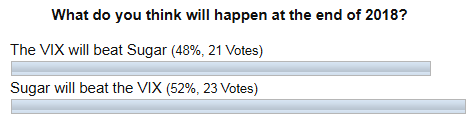
Another half of a year passed with a new year starting its track. It is time to see the result of the 6th Pendulum swing started in the middle of 2018. To remind you, we had pitted the VIX against sugar and below are your bets for that experiment.

Pendulum

You are the best readers I could only dream of as you support my experiment with your real votes for the success of it.

Let’s see which instrument won at the end of the year.

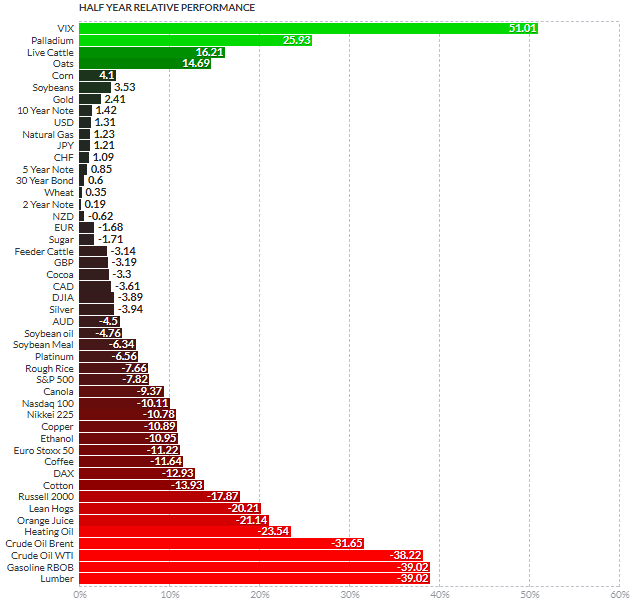
Chart 1. Half Year Futures Performance (Second Half Of 2018)

Pendulum
Chart courtesy of finviz.com

As we can see from this half-year, performance chart sugar couldn’t beat the VIX, which dominated the futures market by a huge margin throughout 2018. One can think that the experiment failed this time, but in my opinion, we have the wrong selection of one input. I am talking about the VIX. The thing is that the underlying asset of these futures is not a commodity, but the “Fear index” or the indicator of the risk approach. Continue reading "Pendulum Swing No.6: Input Error"