Will 2019 Be A Better Year For Bitcoin?

In 2017 Bitcoin became a household name as the price went from below $1,000 per coin at the start of the year to well over $19,000 as the year came to an end. In 2018, the price of the most well-known cryptocurrency fell from its lofty heights to close the year below $4,000 per coin.

As we roll into 2019, some cryptocurrency experts are predicting Bitcoin to break the 2017 record high and fulfill its destiny of going as high as $1,000,000 per coin by 2020. Other more modest expectations have Bitcoin at around the $50,000 range by year end 2019. But the mass consensus of Bitcoin experts has the crypto ending the year in that $20,000 range.

I personally still believe that is way, way, way too high, and I’ll go even as far as saying Bitcoin will end 2019 lower than where it starts the year.

There are two reasons I believe Bitcoin will not perform well in the coming year. Continue reading "Will 2019 Be A Better Year For Bitcoin?"

OPEC's Plan To Institutionalize OPEC+ Has Failed

For over a year, OPEC General Secretary Mohammed Barkindo has been trying to "institutionalize" the OPEC+ arrangement that includes Russia. At the Oil and Money conference in October 2017 in London, Barkindo told reporters. "This platform of 24 countries, now hopefully growing, should be institutionalized."

OPEC+
Source: OPEC

In September, he said, "What we are working on now is to make it [cooperation] more permanent and institutionalize the framework. Our target is to have a longer cooperation framework in place by December when we reconvene in Vienna [for the next OPEC meeting]."

In an interview with TASS on October 22nd, Saudi Energy Minister Khalid Al-Falih explained his view for the long-term agreement he wanted in December: Continue reading "OPEC's Plan To Institutionalize OPEC+ Has Failed"

My First 100 Options Trades

I previously wrote an article walking through the anatomy of an options trade and the mechanics behind long-term successful options trading to generate high probability win rates for consistent premium income. In this article, I will provide empirical data over my first 100 options trades as a supplemental follow-up to this article above. These data are particularly noteworthy for a variety of reasons, most notably due to the market wide sell-off during this period where the Dow and S&P 500 erased all of its gains while turning negative for 2018. Furthermore, a week in December marked the worst percentage drop since the 2008 financial crisis while the Dow and S&P 500 posted their worse December since the Great Depression in 1931. This negative market backdrop provided a true test to the high probability trading and durability of this options trading method. Albeit my portfolio over this timeframe still produced a negative return these returns outperformed the S&P 500 by a wide margin (-8.8% versus -17.2%)

Options trading can mitigate risk; provide consistent income, the lower cost basis of underlying stock positions and hedge against market movements while maintaining liquidity. Risk mitigation is particularly important given the market wide sell-off throughout October-December of 2018. Maintaining liquidity via maintaining cash on hand to engage in covered put option selling is a great way to collect monthly income via premium selling. Heeding critical variables such as implied volatility, implied volatility percentile and probability, one can optimize option selling to yield a high probability win rate over the long term given enough trade occurrences. I’ll demonstrate via empirical data how these critical elements translate from theory to reality. In the end, options are a bet on where the stock won’t go, not where it will go and collecting premium income throughout the process. These empirical data demonstrate that the probabilities play out given enough occurrences over time. Despite a small sample size (100 trades) in a period where the market erased all of its gains for the year and posted the worst quarter since 1931, an 80% win rate was achieved while outperforming the broader market by a wide margin. Continue reading "My First 100 Options Trades"

Fiat Majors Vs. Gold In 2018

It’s time for my traditional yearly post about the dynamics of “modern” money (fiat) compared to the “old” or “perpetual” money (gold) in the current year.

Fiat money is represented by 7 currencies: US Dollar (USD) and 6 components of the US Dollar Index (DXY) placed by weight: Euro (EUR), Japanese Yen (JPY), British Pound (GBP), Canadian Dollar (CAD), Swedish kKrona (SEK) and the Swiss Franc (CHF).

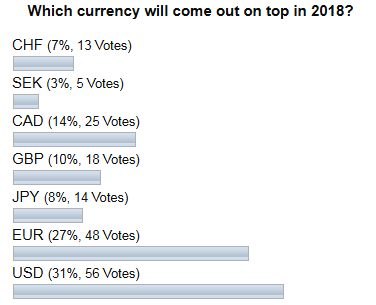
Before we get down to the results of 2018, let us see how did you see the future back at the end of December 2017.

fiat

The most of you bet that the king currency (USD) would beat all the rest in 2018. Your second favorite is the single currency (EUR), which is the top rival of USD.

There could be at least two reasons for this ballot result a year ago. The first one is more obvious and is coming from the country distribution of the INO.com web traffic as more than half of it comes from the United States. The other reason is also logical as the US Dollar was the top loser last year with -10% and you could bet on it using the knowledge about the “Pendulum effect”, which pushes laggards to the top.

Now let’s move on to the results of 2018. Continue reading "Fiat Majors Vs. Gold In 2018"

Sorry, Virginia, There Is No Santa Claus

So who looks more right now, President Trump or Federal Reserve Chair Jerome Powell? Based on the market’s reaction to last week’s Fed rate increase, we’d have to say it isn’t Powell.

That doesn’t mean he isn’t right, at least looking at the situation objectively and what Powell is supposed to be doing as Fed chair. While it’s certainly arguable that the Fed does need to take a pause from raising interest rates for a few months to fully digest the recent economic data, which is showing the economy slowing some – but nowhere near a recession – it is right to continue tightening, no matter how unpalatable that is to the market.

Quite frankly, most of the calls for the Fed to refrain from raising interest rates are blatantly self-serving. Of course, investors don’t want the Fed to ever tighten policy, because, as we’ve seen, higher rates mean lower stock prices. Not many people like that, especially when it’s been ingrained in them over the past 10 years that stock prices only go one way – up – and that “buying the dips” is a no-lose strategy to make up for past losses.

Welcome to reality, folks. Continue reading "Sorry, Virginia, There Is No Santa Claus"