Disney Continues To Deliver

Disney continues to deliver at the box office and theme parks, yet its stock price has been stubbornly stuck in a tight trading range of $98-$110. The Walt Disney Company (NYSE:DIS) can’t seem to break out despite breaking record after record at the box office and throughout its theme parks thus far in 2018. Disney’s brands are ubiquitous and providing long-lasting, durable revenue streams that transcend theme parks, toys, merchandise, streaming initiatives and international reach. Disney’s Marvel franchise posted back-to-back record-shattering $200-plus million weekend openings at the box office for Black Panther and Avengers: Infinity War. Black Panther and Avengers: Infinity War became the third and fourth highest grossing movies of all-time domestically, respectively. Avengers: Infinity War broke through the $2 billion thresholds at the worldwide box office becoming the fourth movie to achieve that feat. If that wasn’t impressive enough, The Incredibles 2 shattered box office records during its opening weekend debut, not only shattering the previous opening weekend record for an animated film but finishing with one of the top ten openings of all-time for a film of any genre. Ant-Man and The Wasp hit theaters as the third Marvel movie thus far in 2018 and is expected to deliver very strong numbers as an ancillary Marvel film during its opening weekend.

Meanwhile Disney's Parks and Resorts are posting strong growth while shoring up its stalling Media Networks segment with a confluence of growth catalysts via streaming with Hulu (30% stake and will likely be expanded to a majority 60% stake after the Fox acquisition), BAMTech, Sling, ESPN streaming service and a Disney branded service coming in 2019 to directly compete with Netflix (NFLX). Disney is closing the gap in streaming as Hulu grows much more rapidly than Netflix and in the backdrop, ESPN and direct to consumer Disney branded streaming service comes to fruition. Disney recently reported Q2 FY2018 revenue growth across every business segment with an overall revenue growth of 9%. Disney offers a compelling long-term investment opportunity considering the growth, Fox acquisition, pipeline, Media Networks remediation plan, diversity of its portfolio, tax reform, share repurchase program and dividend growth. Continue reading "Disney Continues To Deliver"
Stress Test Success and Rising Interest Rates

For traders and investors, the political climate has been unlike anything we have ever seen in recent times!

There are plenty of opportunities if you know where to look. I will help to bridge the gap between Washington and Wall Street, finding you the best stock plays being driven by politics.

  • The Federal Reserve increased its short-term interest rate by a quarter of a percentage point and stated that economic growth has been “rising at a solid rate.”
  • The Federal Reserve indicated that two more rate hikes are likely in 2018 followed by three in 2019
  • A consortium of domestic banks passed the Federal Reserve’s stress test that was more rigorous than last year’s criteria
  • The banks are well capitalized and positioned to withstand severe economic conditions under high unemployment, housing depreciation, and credit defaults
  • Banks are in a position to release largess to shareholders via an increase in dividend payouts, share buybacks, and more unobstructed risk appropriate growth
  • Wells Fargo (WFC), Citigroup (C), Bank of America (BAC) and J.P. Morgan Chase (JPM) received approval for their capital return plans while Goldman Sachs (GS) and Morgan Stanley (MS) received conditional approval

Rising Interest Rates:

Back in March, the Federal Reserve expected the economy to continue to strengthen and inflation to rise shortly. The economic strength coupled with inflation telegraphed an environment that was ripe for more interest rate increases over the near term. This economic backdrop has gained momentum, and the Federal Reserve recently increased interest rates by a quarter percentage point and indicated that two more increases are highly likely in 2018 for a total of four this year. The consensus from the committee was perceived as very bullish on the domestic front and that the Federal Reserve will continue on its path of rising interest rates along with higher inflation expectations. In March, the committee stated that “tax changes enacted late last year and the recent federal budget agreement, taken together, were expected to provide a significant boost to output over the next few years” and more recently economic growth has been “rising at a solid rate,” unemployment has “declined” and household spending “has picked up.” The committee sees economic growth hitting 2.8 percent for the full year followed by 2.4 percent in 2019. The committee also indicated it continues to expect three more rate hikes in 2019. "The committee expects that further gradual increases in the target range for the federal funds rate will be consistent with the sustained expansion of economic activity, strong labor market conditions and inflation near the committee's symmetric 2 percent objective over the medium term." Provided this backdrop of positive economic commentary, financials such as Goldman Sachs (GS), J.P. Morgan Chase (JPM), Citigroup (C) and Bank of America (BAC) are poised to benefit as a result. Continue reading "Stress Test Success and Rising Interest Rates"

Pendulum Swing No.5: Back To Success!

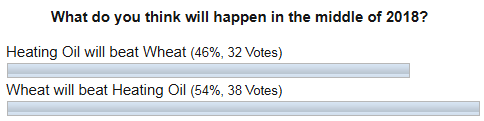
It’s time to announce the result of the 5th Pendulum swing pushed this January. In that race, I put heating oil (ultimate futures winner in the second half of 2017) vs. wheat futures (the top loser). The Pendulum effect favored the top loser, i.e., wheat to beat heating oil in the six month period. The image below contains the poll results of your voting for that experiment.

Image 1. Poll results

CBOE Volatility Index (VIX)
Chart courtesy of INO.com

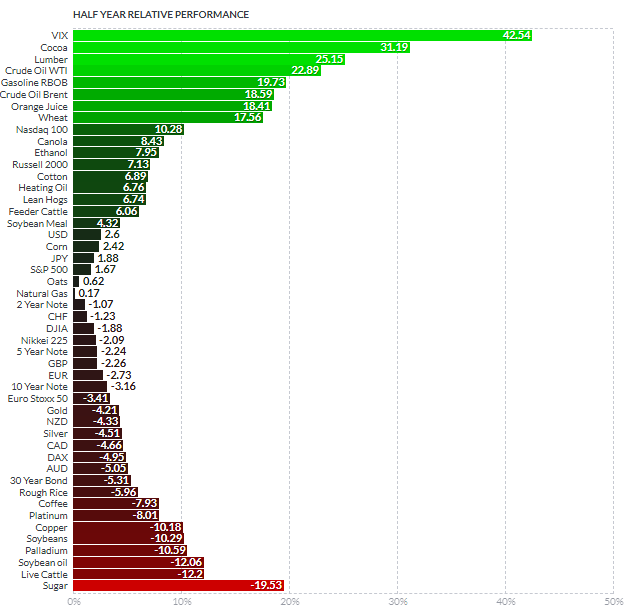
Bingo! The majority of you guessed right choosing wheat as a winner and as you can see in the next chart that wheat has gained +17.56% as heating oil gained only +6.76. I would like to express my gratitude to those who chose the experiment success option for your trust! So after the first failure in the second half of 2017 (4th swing), the Pendulum experiment is back on a winning track! Let’s try it again and see what happens.

Chart 1. Half Year Futures Performance (First Half of 2018)

CBOE Volatility Index (VIX)
Chart courtesy of finviz.com

This time we will have an interesting race as the winner in the first half of 2018 is not a commodity, but the CBOE Volatility Index (VIX) also known as the stock market fear gauge. It gained more than 40%, leaving its rivals far behind amid the roller-coaster ride in the S&P 500.

On the other side, which is red, there is the biggest loser, sugar with an almost 20% loss in the first half of 2018. The supply glut in the sugar market undermined the price for this commodity significantly. Continue reading "Pendulum Swing No.5: Back To Success!"

Oil and Gas ETFs Are Having a Good 2018

Thus far in 2018, the oil and gas industry has been booming. Rig counts in the US are up, prices at the pump are up, and the oil and gas ETFs tracking the sector are up by a lot.

Investors who have been following the industry over the past year could have made some serious money as a few of the leveraged ETFs are up 238% or more. The Velocity Shares 3X Long Crude Oil ETN (UWT) is up 247% over the last 12 months and is up more than 70% year-to-date. The UBS ETRACS ProShares Daily 3X Long Crude ETN (WTIU) has risen 240% over the last year and 64% year-to-date. Finally, the Proshares UltraPro 3X Crude Oil ETF (OILU) is up 238% over the last 12 months and 63% year-to-date.

But, perhaps your less risky and don’t like investing in the leveraged ETFs? Well, you still could have done well as the United States Brent Oil Fund LP (BNO) is up 71% over the last year and 19.9% since the start of 2018. Or perhaps you went with the ProShares K-1 Free Crude Oil Strategy ETF (OILK) which is up 62% in the past 12 months and 23% year-to-date. Or either the iPath Series B S&P GSCI Crude Oil ETN (OILB) or the United States Oil Fund LP (USO) which are both up more than 61% over the last year and 23% year-to-date.

There have been some reasons why the industry has been on a tear over the last, and many of that reason don’t show signs of changing in the short term. OPEC is committed to increasing the price of oil (despite its recent modest increase in production), smaller US outfits still need slightly higher prices before they can add additional rigs and become profitable, the economy appears to be healthy and growing, US consumers have not yet begun to fell the “pain at the pump” again really. Continue reading "Oil and Gas ETFs Are Having a Good 2018"

Oil Price Implications Of OPEC's New Oil Deal

OPEC concluded its meeting on June 22nd with a vaguely-worded communique about its oil deal:

“Accordingly, the Conference hereby decided that countries will strive to adhere to the overall conformity level of OPEC-12, down to 100%, as of 1 July 2018 for the remaining duration of the above-mentioned resolution and for the JMMC to monitor and report back to the President of the Conference.”

At the press conference afterward, OPEC president HE Suhail Mohamed Al Mazrouei, UAE Minister of Energy and Industry, struggled to explain exactly what it meant. When asked how many barrels would be added, he remarked that “you can do the math” between current output and the 100 percent conformity level, although he later said it was about one million barrels per day.

However, at the press conference of the 4th OPEC and non-OPEC Ministerial Meeting on June 23rd, oil ministers Khalid al-Falih of Saudi Arabia and Alexander Novak of Russia, responded to questions, explaining the new deal and how it would be implemented.

But Iran’s oil minister later said that OPEC’s oil output agreement did not specify a production increase, which probably explains why the agreement was left vague. It also explains Mr. Al-Falih’s unusual remark at the press conference: Continue reading "Oil Price Implications Of OPEC's New Oil Deal"