Oil Prices Break-Out of Trading Range

Robert Boslego - INO.com Contributor - Energies


Oil futures prices have broken above the trading range where they have been since February when the market was expecting supply and demand would balance quickly as a result of the OPEC/non-OPEC deals. But those hopes were dashed because the global demand was in a seasonal decline, and inventories remained stubbornly high.

Prices managed to break higher due to a combination of circumstances:

U.S. and Global Inventories

Hurricane Harvey in the U.S. Gulf of Mexico (GOM) disrupted refinery operations, causing product stocks to draw rapidly. It was followed by Hurricane Nate, which disrupted crude oil production in the GOM.

In addition, U.S. crude exports reached record levels recently, averaging 1.744 million barrels per day (mmbd) over the past four weeks, a gain of 293 % from the same weeks a year ago. Petroleum product exports have also been strong, averaging 5.125 mmbd in the same period, up 23% v. a year ago.

Together, these trends have reduced U.S. inventories by 40 million barrels since the week ending September 8th. Global OECD stocks have dropped about 51 million barrels from May through September, though this is largely due to normal seasonal trends. Continue reading "Oil Prices Break-Out of Trading Range"

Covered Calls and Covered Puts - Empirical Results and Lessons Learned

Leveraging Options

I’ve written numerous articles on options trading and how one can leverage options over the long-term to mitigate risk, generate income and accentuate returns. Leveraging options to supplement portfolio returns can make a meaningful impact on overall returns, especially over the long-term. Here, I’ll focus on covered calls and covered puts with corresponding lessons learned over the course of the past year with empirical data.

Covered calls are intended to leverage a stock position while extracting value on a consistent basis via selling option contracts against that position and collecting premium income in the process. I liken this to a landlord renting a room for monthly income, however, in this case, one is renting the stock. The option contract is structured with the option seller (stock owner) collecting a premium in exchange for the right for the option buyer to purchase the shares of interest at an agreed upon price by an agreed upon date for a premium (income that the option seller will receive). In this scenario, the stock owner doesn't believe that the shares will appreciate beyond the agreed upon price and thus be able to collect income while retaining the shares and dividend rights. The option buyer believes that the shares will appreciate beyond the agreed upon price and be able to buy the shares at a lower price than the market currently trades.

Covered puts involve leveraging a cash position that one currently has on hand and collecting a premium in exchange for the obligation to purchase one’s shares at an agreed-upon price prior to an agreed upon date. If the stock falls below the agreed-upon price prior to the agreed upon date, then the individual that bought the contract from you will force the obligation (that you agreed to) for you to purchase the shares. In this case (when the stock falls throughout the contract lifespan), the shares can be sold to you (the put option seller) at a higher price than the market. However, if the shares rise in value then the shares will remain with the owner and the put option seller will keep the premium income and the cash earmarked for the potential purchase of the shares will be freed. Why exercise the contract and sell the shares to you (option seller) at a lower price when one can sell the shares on the open market at a higher price? Continue reading "Covered Calls and Covered Puts - Empirical Results and Lessons Learned"

Bitcoin Pigs Get Fat, But The Hogs Are Going To Get Slaughtered

Matt Thalman - INO.com Contributor - ETFs


Unless you have head your head stuck under a rock for the last 12 months, you have heard of Bitcoin and how the price of the first crypto-currency has skyrocketed this year. After hearing about this 'once in a lifetime investment opportunity,' I am sure most of you have thought about buying some digital currency. Maybe some of you have even taken the next step and bought some. (Congratulations to those of you who did.)

But as the saying goes, 'Pigs get fat, hogs get slaughtered,' I hope for your sake you are a pig and get out while you can. Unless you got your hands on some Bitcoin's in the last week, you have made money.

A recent Bank of America Merrill Lynch survey found that the Bitcoin traded is one of the most crowded trades on Wall Street, which obviously explains some of its massive run-up. Bitcoin's amazing performance over the last year now appears to have attracted some very risk-averse investors.

We have seen the price of Bitcoin fall 30%, 40%, even 50% in just a years' time. But, investors keep running into the asset and pushing the price to new all-time-highs.

So what would actually cause a Bitcoin collapse? Continue reading "Bitcoin Pigs Get Fat, But The Hogs Are Going To Get Slaughtered"

HUI Is Testing Support, XAU Is Yet To Try

Aibek Burabayev - INO.com Contributor - Metals


Much to my dismay, I’ve never covered these hot indices in my posts. I detected some interesting chart patterns as well as significant price actions and thought if it might be interesting to cover and discuss.

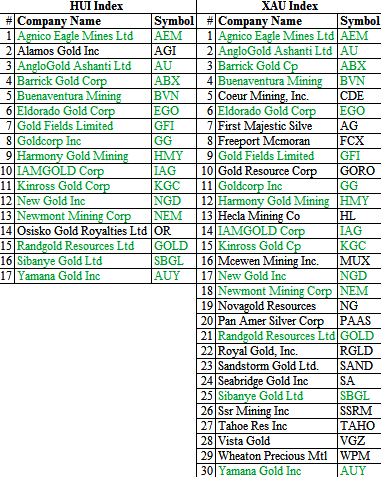
These indices have a long trading history as well as great companies that are tracked by each index. The NYSE Arca Gold BUGS Index (HUI) and Philadelphia Gold and Silver Index (XAU) are the two most watched gold indices on the market. The main difference between them is that the HUI Index’s components are only gold producers (17 companies) whereas the XAU Index includes both gold and silver miners (30 names). Below is the table of listings for comparison.

Table 1. Current Composition of Indices

XAU and HUI Index Listings

I highlighted the matching companies in green so you can easily see the difference between the indices. It is evident that the HUI index almost entirely sits in the XAU index (15 out of 17 names are in), the latter in its turn covers broader the precious metals market. Let us see in the charts below their dynamics and possible price action. Continue reading "HUI Is Testing Support, XAU Is Yet To Try"

Housing Starts Down In September A Sign You Should Buy Housing Related ETF

Matt Thalman - INO.com Contributor - ETFs


Housing starts for September came in at 829,000 units, lower than the 851,000 units reported in August. Some economist and market participants are saying the weak housing starts are a sign the economy is beginning to show signs of wear.

Others have noted that 15.3% of the decline in starts came from parts of the country that were affected by hurricane Harvey and Irma. Furthermore, we can't forget about the wildfires in California, which may not be as impactful as the hurricane's, but still likely played some role in the decline.

Another data point that points to the health of the housing market is the National Association of Home Builders reported their Housing Market Index. In March of this year, the National Association of Home Builders reported their Housing Market Index hit a 71, just one point lower than its all-time high of 72 which was set in June of 2005. If you recall, shortly after June 2005 the housing bubble began to burst, and the housing crisis took down the U.S. economy. The NAHB report their Housing Market Index was at a 68 in October.

What is again interesting about these data point is that when the NAHB's Market Index hit its all-time high in 2005, the housing starts number was at 1.8 million.

Home builders have cited land and labor shortages for the 'low' number of housing starts. This could be a big problem for those looking to buy a home in the future because it could cause prices to skyrocket. But at the same time, that doesn’t mean the home builders will be making money hand over fist because remember their cost is going higher. Continue reading "Housing Starts Down In September A Sign You Should Buy Housing Related ETF"