
Biotech's Upward Trend - IBB Breaks $300

Noah Kiedrowski - INO.com Contributor - Biotech


Introduction and Backdrop

As of recent, the iShares Nasdaq Biotechnology ETF (NASDAQ:IBB) has caught an upward trend and briefly crossed the $300 per share threshold for the first time over the past 9 months. The political backdrop has been very contentious and even more so after two of the three presidential debates have wrapped up. I’ve written several pieces evaluating the massive sell-offs in the biotech sector and how extraneous events such as oil, China, interest rates and to a large extent political threats are merely noise in the larger picture. These external events provide great buying opportunities in high-quality companies or the cohort itself as represented by the sector ETF, IBB as a proxy. There’s no doubt that there’s at least a loose correlation if not a direct correlation between opportunistic political posturing by political front-runners (i.e. Hilary Clinton and Bernie Sanders) and the chronic price suppression of IBB. Each time a tweet is pushed out to social media regarding drug pricing and/or specific attacks on pharmaceutical companies, the entire cohort takes a significant hit as reflected in the price action of IBB. I contend that political posturing played a major role in the sell-off of the healthcare cohort and more specifically biotech stocks. Drug pricing was used as a centerpiece and scapegoat for political gains. Continue reading "Biotech's Upward Trend - IBB Breaks $300"

Freeport-McMoRan Could Be In Trouble As Copper Approaches A Decision Point

Aibek Burabayev - INO.com Contributor - Metals


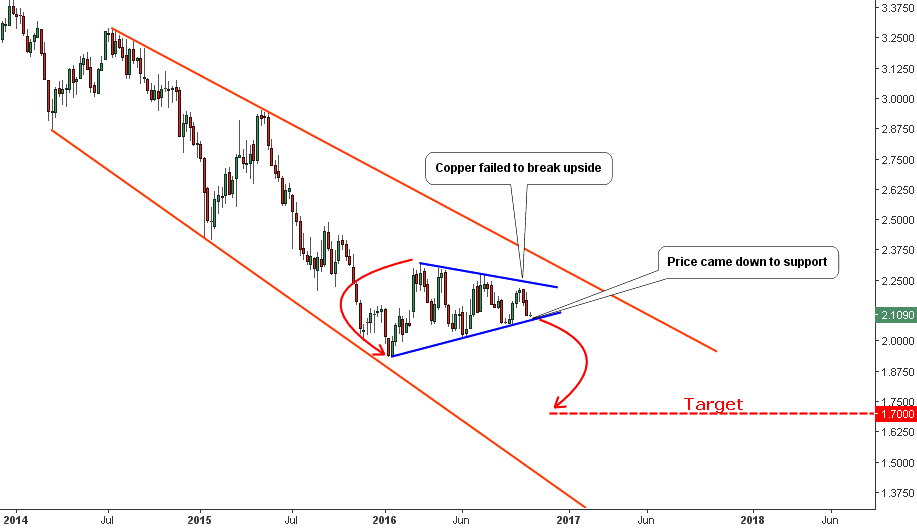
The background for the copper market is not brighter these days as the macroeconomic data of the top metal consumer - China points at the cooling economy. Asian traders stored up the metal at the start of this year, pushing the price above the $2 mark to a high of $2.3. Nowadays weakening demand puts pressure on copper prices as the Chinese currency hit a 6-year low against the dollar which makes the import more expensive.

Chart 1 Copper Weekly: Support Is At The Gunpoint

Weekly Copper Chart
Chart courtesy of tradingview.com

Copper’s price has been descending within an orange expanding downtrend for the past two years. The Contracting Triangle pattern (highlighted in blue) reflects the sideways structure of the market this year. Continue reading "Freeport-McMoRan Could Be In Trouble As Copper Approaches A Decision Point"

The Fed Tease Continues - But For How Much Longer?

George Yacik - INO.com Contributor - Fed & Interest Rates


Way back in high school, my freshman algebra teacher told us about Zeno’s Paradox, which the Greek philosopher (Zeno, not my teacher) explained through the story of Achilles and the Tortoise. According to the story, the two were engaged in a footrace, but no matter how much faster Achilles could run compared to the tortoise, he could never quite catch up to him. Why? Because while Achilles could consistently halve the distance between himself and the slower-footed reptile, the gap between the two could be reduced fractionally an indefinite number of times, so, therefore, he could never catch up – theoretically speaking, of course.

I was reminded of that story when I read the media headlines about the release last week of the minutes of the Federal Reserve’s September 20-21 meeting. Once again, the Fed said it was almost, but not quite, ready to tighten monetary policy. This time, the Fed used the words “relatively soon” to describe the timing of its next rate increase, which would be the first one since last December.

“Several members judged that it would be appropriate to increase the target range for the federal funds rate relatively soon if economic developments unfolded about as the committee expected,” the minutes said. Also, those members – still the majority – who still wanted to “await further evidence” before voting for a rate hike said it was a “close call” in their decision to wait.

In other words, like Achilles chasing the tortoise, the Fed just keeps getting closer and closer to raising rates but just never gets to that point. Continue reading "The Fed Tease Continues - But For How Much Longer?"

Gold Bulls Have Last Fifty Bucks To Survive

Aibek Burabayev - INO.com Contributor - Metals


The current situation in the precious metals markets very well illustrates how patience in trading can save money for the trader. It means that a trader who waits for the confirmation of the price action has an ample advantage compared to those who choose assumption mode entering the market without confirmation. In other words, the ‘trade what you see’ method is way safer than the ‘trade what you assume’ method. For many years in trading, again and again, I see how true the words said above, especially during market consolidations.

The corrective chart structures are unpredictable though very dangerous, especially for newcomers. As I wrote earlier such structure shows the market’s indecision with a lot of hesitant zigzags which have no clear ending point both in time and in the price level and therefore are risky. Continue reading "Gold Bulls Have Last Fifty Bucks To Survive"

How Saudi Arabia Will Manage the Oil Market in 2017

Robert Boslego - INO.com Contributor - Energies


OPEC agreed in Algeria to limit future oil production. This represents a major shift in the policy announced in November 2014 to compete for market share through lower prices.

The OPEC communique stated the group will retain output to a "target range of 32.5 to 33.0 million barrels per day" (mmbd). In the latest OPEC Monthly Oil Market Report (MOMR), OPEC reported that production average 33.4 mmbd in September. While that is not far above the target range, there are other problems looming on the horizon; several countries—Nigeria, Iran, Iraq, and Libya—all want to restore their output to levels they were at before their supplies were disrupted, and that could push OPEC’s output up to nearly 35 mmbd if they succeed.

Saudi Energy Minister Khalid Al-Falih reversed KSA’s position from last April when it would not freeze output without Iran’s agreement to do the same. Instead, he said, Iran, Nigeria and Libya would be allowed to produce "at maximum levels that make sense as part of any output limits which could be set as early as the next OPEC meeting in November."

My interpretation is that Saudi Arabia and the smaller Gulf producers are therefore going to have to absorb the cuts if they intend to achieve the target. Continue reading "How Saudi Arabia Will Manage the Oil Market in 2017"