Gold Eyes All-Time High As Silver Targets Former Top

I spotted hot trading opportunities for you on daily charts, so let’s skip straight to it. Gold will be the first.

Gold
Chart courtesy of tradingview.com

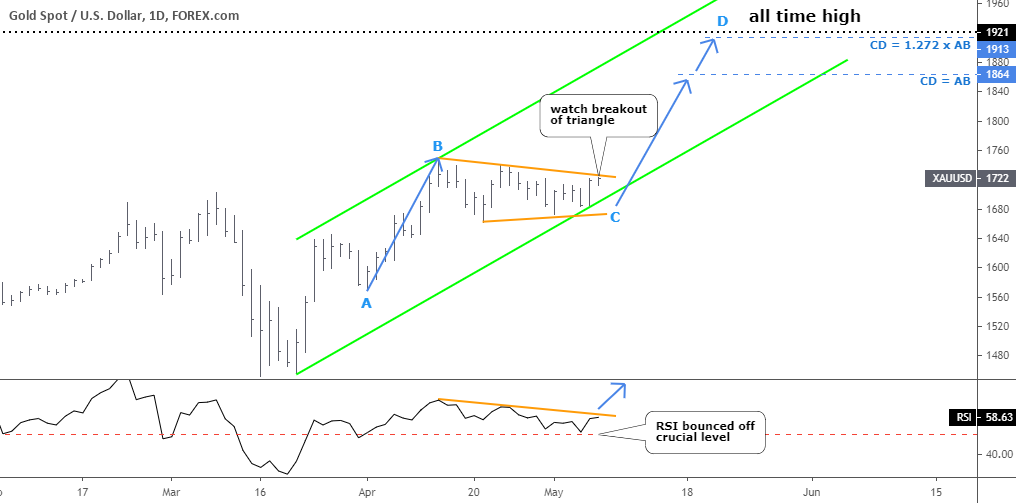
Gold got stuck in a sideways consolidation after it hit a new high of $1748 in the middle of April. The lower peaks and higher troughs shaped a very familiar pattern of a contracting triangle (orange trendlines). The price has reached the upper side of that pattern as I write this post. Watch the price to break up out of the triangle to confirm the move up. Continue reading "Gold Eyes All-Time High As Silver Targets Former Top"

Disconnect? What Disconnect?

Over the past few weeks, the financial news media has been marveling at what it calls the “disconnect” between stock prices and the economy. Economic and health statistics are likely to go from bad – 30 million unemployed in the past month, a 4.8% drop in first-quarter GDP, an 8.7% drop in retail sales in April, more reported coronavirus cases and deaths – to worse – a nearly 40% drop in GDP and around 15% unemployment in the second quarter, according to the Congressional Budget Office’s latest projections. Yet the stock market has blissfully regained about half of the 34% drop it sustained between mid-February and mid-March.

But is there really a disconnect? Does the economy – now largely controlled by the Federal Reserve and the U.S. Treasury Department – still have any correlation to what happens in the stock market anymore, and vice versa? Well, the answer is yes, but not in the way it used to. What’s happening is that as the economy goes deeper into the red, the more it prompts the government to pump in more money and for the Fed to intervene more in the financial markets. That is unquestionably good for stocks.

We have been in an environment since the 2008 financial crisis where the Fed has played an unprecedented activist role in the bond market and, indirectly, the stock market. That role has grown further under Chair Jerome Powell, who seems to believe it’s the Fed’s job to rescue equity investors any time stock prices correct, never mind what’s going on in the economy. Now that we’re in the middle of an economic downturn that makes 2008 look like a garden-variety recession, the Fed has put its monetary policy and quantitative-easing engines into Continue reading "Disconnect? What Disconnect?"

Oil ETFs For When and If The Industry Turns A Corner

The word 'wild' doesn't even start to describe the oil markets over the last few weeks. We saw a price war between Russia and Saudi Arabia after world economies shut down to slow the spread of Covdi-19. Then an agreement between Russia, Saudi Arabia, and the other OPEC+ countries. That was followed by negative prices on futures contracts in the US. Majors changes to how large oil industry ETFs operate and several funds closing altogether. And then oil began to recover as inventory levels weren't as bad as many expected them to be.

So, your guess is as good as mine in terms of what happens next. However, most would agree that when world economies begin to open back up and operate in some form of 'new normal,' we will likely see demand for oil increase, which will probably send the prices higher, if not at least stabilize them. With that sort of thinking, there are a few ETFs you may want to put on your watch list and consider buying when you feel the mayhem, we experienced over the last few weeks is over.

The first is the SPDR S&P Oil & Gas Exploration & Production ETF (XOP). The XOP has 57 holdings with an average weighted market cap of $21 billion. The fund also has a distribution yield of 3.05% and an expense ratio of just 0.35%. XOP has over $2.12 billion in assets under management, making it one of the largest oil and gas-focused ETFs you can buy. Furthermore, the fund offers an equal-weighted approach, so it is not weighed down by just a few big names in the industry. However, give the fund a little more risk during a time like now because if some of the smaller firms struggle, they do matter more to the fund than if the ETF was weighted differently. Continue reading "Oil ETFs For When and If The Industry Turns A Corner"

U.S. Crude Oil Production Peaked In February

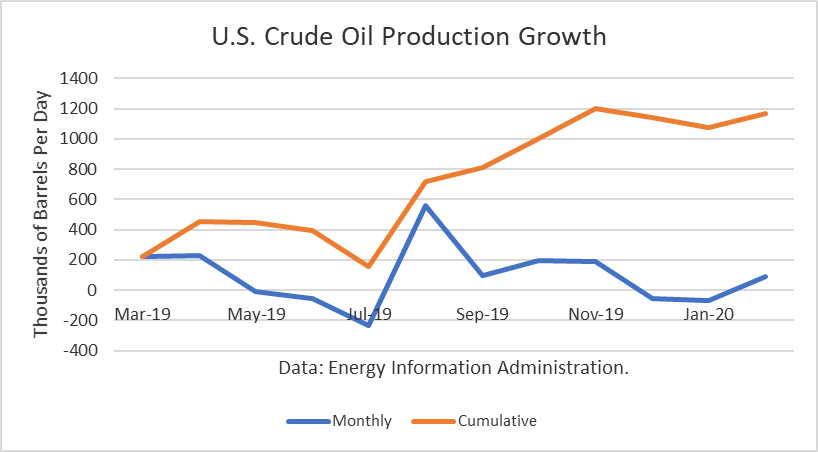
The Energy Information Administration reported that February crude oil production averaged 12.833 million barrels per day (mmbd), up,000 b/d from November. Reductions occurred in the Gulf of Mexico (87,000 b/d). Because of the oil price war and demand destruction, the collapse in oil prices likely undercut output in March, making February the peak in U.S. production.

Output rise in the Gulf of Mexico (41,000 b/d), New Mexico (37,000 b/d), North Dakota (27,000 b/d), and Oklahoma (27,000 b/d). Texas production fell by 5,000 b/d from its January all-time high.

Crude Oil

The gains from last March have amounted 1.164 mmb/d. And this number only includes crude oil. Other supplies (liquids) that are part of the petroleum supply fell 390,000 b/d from a year ago. Continue reading "U.S. Crude Oil Production Peaked In February"

Palladium Is At Decision Point: Fly Or Die?

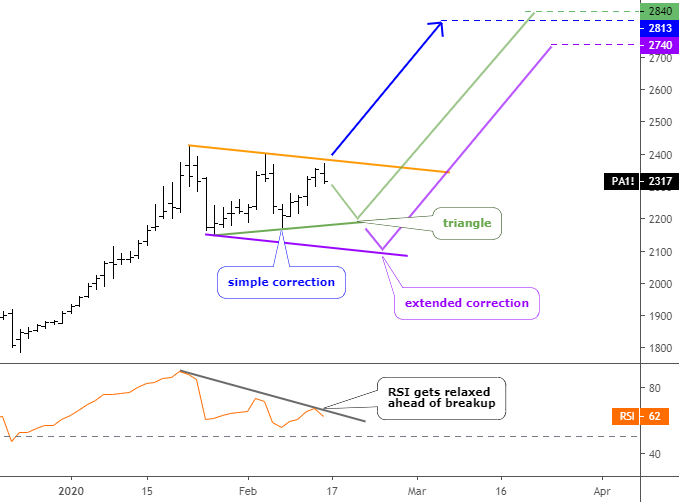
Sometimes forecasts play out right after it you post on the Blog. This was true for the piece published in February when I wondered if “Another All-Time High Ahead For Palladium?”. The target set in the daily chart in the $2800 area was reached within 10 days as the metal burst into uncharted territory to book a hefty profit of 22% or $500.

To remind you, I suggested three possible scenarios of how the palladium price could go in February. The original chart is below to refresh your memory.

Palladium
Chart courtesy of tradingview.com

Below are your votes on the future of palladium. Continue reading "Palladium Is At Decision Point: Fly Or Die?"