Crude Oil Slips Ahead Of Doha Meeting

Crude Oil (NYMEX:CL.K16.E) is falling for the 3rd straight day and is currently trading near session lows. But why the sudden drop you may be asking.

OPEC producers are due to gather in Doha on Sunday, to discuss whether to freeze oil production output at January's levels. Oil is dipping this morning as hopes of a deal between oil producers has faded. Hopes had been that OPEC would agree to freeze output, but it seems that Iran has other plans. Iran has already stated that it won't agree or adhere to a production freeze as it looks to boost its production. Reason being that sanctions on its oil sales were just lifted in January.

As you can imagine the other OPEC producers are desperate to make a deal and to raise the price of oil. After all, low crude prices have cost them billions of dollars so far.

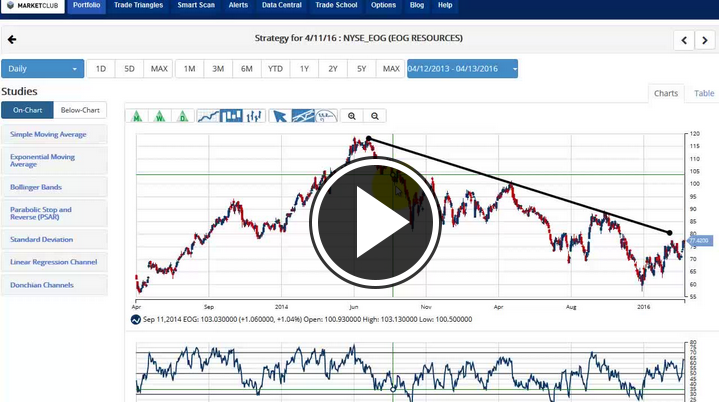
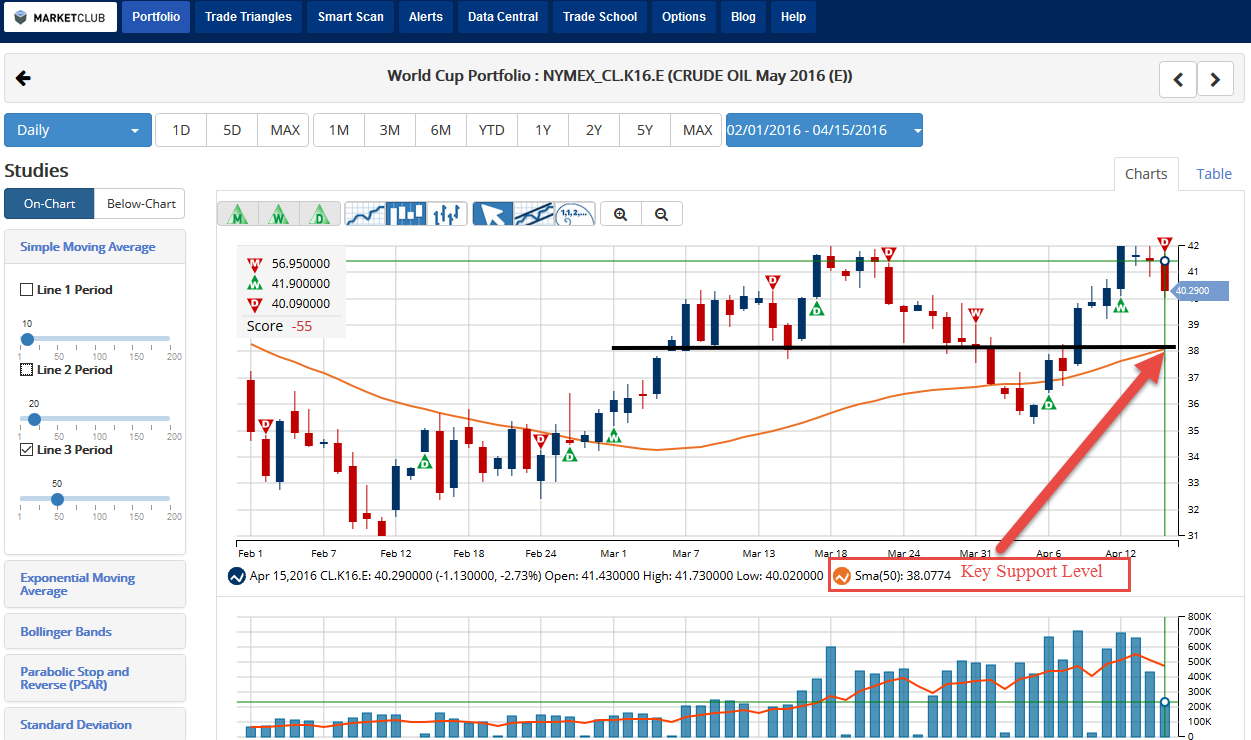
If you take a look at the chart, you can see that the Trade Triangles entered into a sidelines position today. This is based on the red daily Trade Triangle that triggered at $40.09 this morning.

Daily MarketClub Chart of Crude Oil (NYMEX:CL.K16.E)

Key Levels To Watch:

1. 38.07 - The 50-day moving average provides the key level of support at 38.07. If this level is breached, oil could drop to $30 a barrel.

2. 35.24 - The weekly Trade Triangle will change to red if oil breaks through this level. This would confirm a move to the downside and further weakness.

3. 42.16 - The daily Trade Triangle will change to green if oil breaks through this level. This would confirm a move to the upside and further strength.

As we head into the weekend, I think that the sidelines positions indicated by the Trade Triangles is the best place to be based on the uncertainty of the outcome of the Doha meeting.

Have a great weekend!

Every Success,
Jeremy Lutz
INO.com and MarketClub.com

A Value Stock That's Out Of This World

Daniel Cross - INO.com Contributor - Equities


Value investors know that the long game is important when picking a stock. Short term gains fluctuate, but solid fundamentals mean that a company will outperform over the long-term regardless of temporary ups and downs in the market.

A few decades ago the field of technology was in its infancy and the computer space was considered highly risky and volatile. Of course, anyone who bought into companies like Apple or Intel back then are certainly reaping the rewards today.

Technology is still an investor's best bet for finding the next breakout industry. Right now IoT (Internet of Things) is the frontrunner with advances being made in data storage, infrastructure, and other forms of "smart" tech. Big data stocks and chipmakers have already seen big gains in the past couple of years and should continue to thrive. But there's another industry that looks very much like computers did back in the late 70's and early 80's – spaceflight.

The introduction of commercial space agencies is brand new. Richard Branson helped kick off the new space race with his Virgin Galactic company and now Elon Musk and Jeff Bezos have joined in with their SpaceX and Blue Horizons companies.

While still privately owned entities, there are still ways for investors to hop aboard this exciting new enterprise. Satellite telecommunications hasn't been an industry in focus for Wall Street analysts, but rapidly growing interest in spaceflight and space-related technology means that these companies may be about to enter a new bullish environment that could last decades. Continue reading "A Value Stock That's Out Of This World"

Topping Euro Signals New Highs For Precious Metals

Aibek Burabayev - INO.com Contributor - Metals


This past January I wrote about European gold discussing two possible scenarios as the market was at the crossroads. The upside scenario played out. It is good to act once we know the direction as it gives us more confidence. Today I will review gold vs. euro and add silver to the pack. But the very first chart I will dedicate to the peaking euro as the price of the metals is quoted in a single currency.

Chart 1. Euro/$ Weekly: Price Is At The Top
Weekly Chart of Euro/Dollar
Chart courtesy of tradingview.com

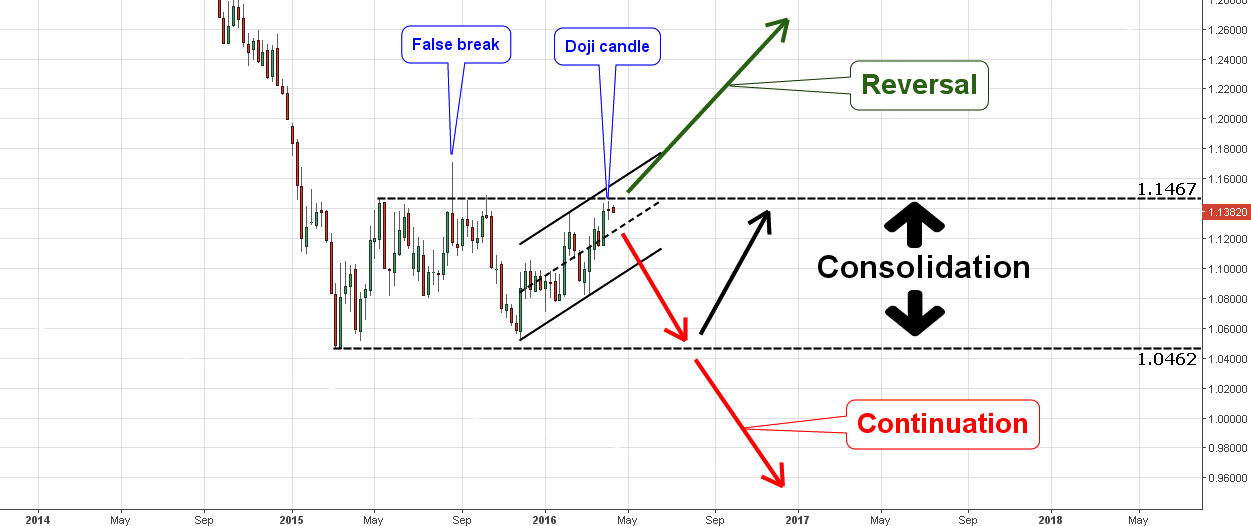
The EURUSD is the most liquid currency pair in the world and it shows the strength of the US dollar, which is the measure of everything in the financial world. The global trend for the pair is down. The Euro hit a multi-decade bottom in 2015 and since then we have been stuck in a wide consolidation with a price range of 10 big figures within $1.0462-1.1467. I didn't take the 2015 high at $1.1714 as you can see that it was just a false break above the horizontal resistance. The price quickly fell back below resistance and closed a dip below it.

Last week shaped a reversal Doji candle, which, of course, needs further confirmation on the chart. We should see a quick drop below the middle of the channel (black dashed line) at the $1.1240 level.

The euro should break below $1.0462 to confirm the continuation of the global trend; it will certainly add to the bullishness of precious metals against this currency. If we get a weekly/monthly close above $1.1467, then we should watch closely after the reversal which will undermine the metals market in Europe. The third path is a prolonged consolidation as a result of the price reversal from the lower margin at $1.0462.

Chart 2. Gold vs. Euro Monthly: Break Up & Correction, Ready For Action!
Monthly Chart of Gold vs. Euro
Chart courtesy of tradingview.com

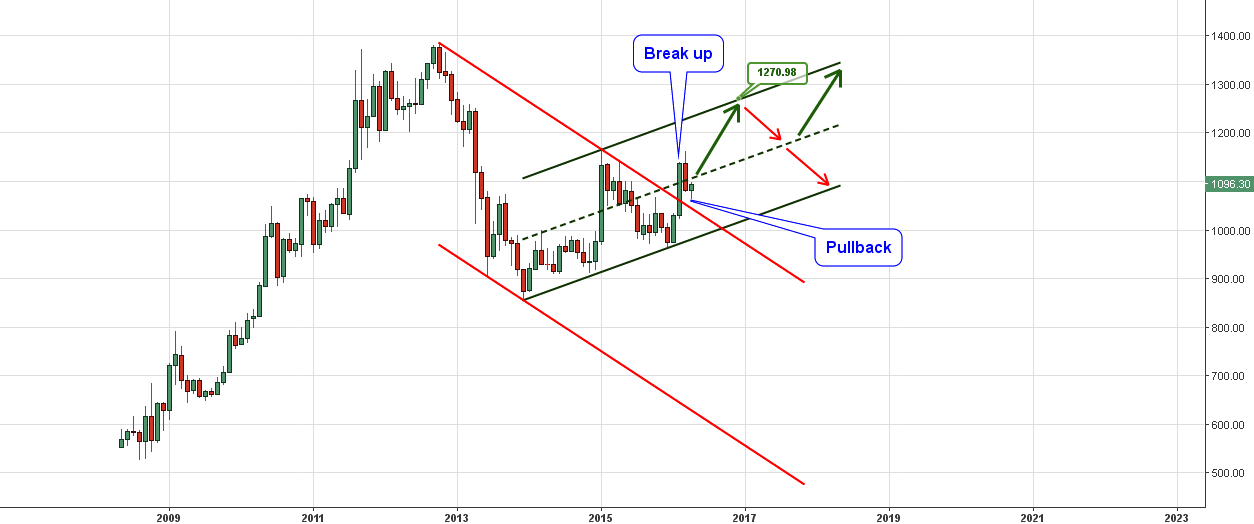
Gold was nimble enough to penetrate the upside of the downtrend at EUR 1065 in February. It is a good trigger for buyers. Patient traders prefer to wait for a good pullback to enter with safe stop (just below the trend) for a low-risk trade. And we can see this classic price action on the chart. It looks like the pullback has finished at the low of EUR 1065 (same price for the breakup) as the price rapidly advanced higher. Once the price passes the high at EUR 1165, we can move the stop to breakeven and enjoy the lossless bet.

The target is located on the upside of the trend at EUR 1270, if you read the earlier gold-euro post, you can see that the AB/CD concept also points to that level (EUR 1272). It's not a coincidence as both the trend model and the AB/CD concept use simple mathematical calculations.

Chart 3. Silver vs. Euro Monthly: Wait for Breakout!
Monthly Chart of Silver vs. Euro
Chart courtesy of tradingview.com

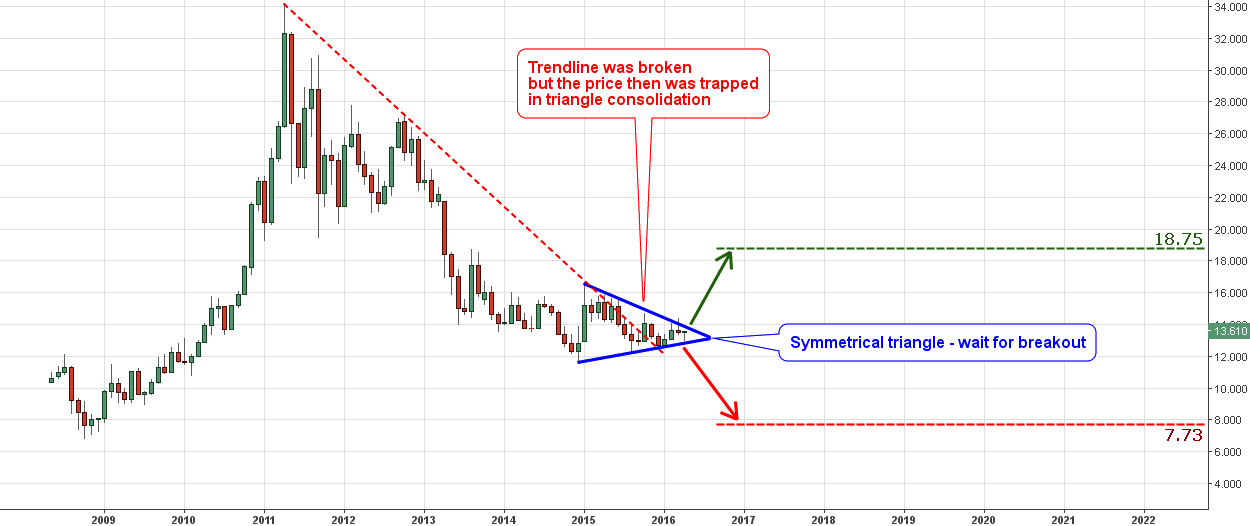
Silver didn't follow gold yet. Indeed, the price penetrated the dashed red trendline last October, but we didn't see the follow-through upside price action so far. Instead, the metal has been squeezed with a decreasing apex of the symmetrical triangle (highlighted in blue), one of the typical visual forms of consolidation.

It's good to trade on the breakout. The most expected action is upside penetration of the triangle amid rising a gold price. The target for the upside move is located at the EUR 18.75 level, calculated as a distance of the base (EUR 4.9, the widest part of the triangle) added to the break point. This is the area of the 2013 August high. In a less probable downside scenario the target is set at EUR 7.73 level.

Intelligent trades!

Aibek Burabayev
INO.com Contributor, Metals

Disclosure: This contributor has no positions in any stocks mentioned in this article. This article is the opinion of the contributor themselves. The above is a matter of opinion provided for general information purposes only and is not intended as investment advice. This contributor is not receiving compensation (other than from INO.com) for their opinion.

Energy Is The Name Of The Game

Hello MarketClub members everywhere. Many large, well-known energy companies triggered major buy signals yesterday based on green monthly Trade Triangles. In today's video, I will be looking at three energy stocks tied to crude oil which also gave buy signals yesterday. There is still a little bit of resistance just above the market in crude oil, but I expect that to be taken out and for oil to move to the upside in the days and weeks ahead.

MarketClub's Mid-day Market Report

Here are the three stocks that I will be analyzing today. Continue reading "Energy Is The Name Of The Game"

What's Really Happening With The Japanese Yen?

Lior Alkalay - INO.com Contributor - Forex


The Japanese Yen is making headlines, again. The Dollar-Yen trade pierced through the 110 support level and the Bank of Japan's credibility is at stake. It's only a matter of time before the BoJ swings its "sword" and slice rates again, or at least, so it seems. But while Yen strength has caused quite a stir in Japan, its origins, this time around, are rooted elsewhere.

Wall Street is flat, European bourses are falling and China isn’t out of the woods just yet. Japanese corporates keep hoarding cash and, of course, they need to park it somewhere. That “somewhere” is their default choice; i.e. repatriate the cash and buy into the safety of Japanese Government Bonds.

Chart of the Japanese Yen
Chart courtesy of Bloomberg Press

As illustrated in the chart, when comparing the Bloomberg Japan Sovereign Bond Index with S&P500 and Nikkei 225, demand for Japanese Government Bonds has been strong. Japanese Government Bonds beat both the S&P500 and the Nikkei 225 for the passing year. And that’s even more interesting when you consider the negative yields—it actually costs to hold Japanese Government Bonds.

How long can Japanese corporates keep repatriating funds and pay for the "privilege" to hold Japanese Government Bonds? Continue reading "What's Really Happening With The Japanese Yen?"