U.S. 10-Year Yield: It's Not "If" But "When"

Life is full of surprises as we never know what could happen next, and it is the true phenomenon of our existence. Last time I shared my thoughts about the U.S. 10-year yield (10Y) in September of 2018 calling for a rise to 3.33% and more. JPMorgan Chase CEO Jamie Dimon warned that time to be prepared for a 5% 10-year yield. Let’s take a look a what you thought then.
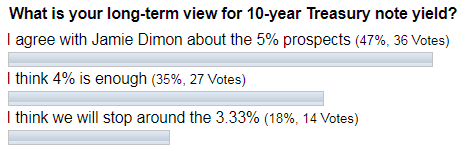
10-Year Yield

Most of you agreed with JPM’s CEO and hit the 5% option. The atmosphere then was so elevated that it was easy to believe that the rates would keep rising. Indeed, the market went higher but stopped at the 3.26% mark, and that was it. The least favored target of 3.33% appeared to be the closest call.

The precious metals’ posts schedule was busy here on the blog at the end of last year, so I posted my call at tradingview.com for 10-year yield to drop to tag the previous low of 1.34% on November 14th of 2019. Below is the chart of that post. Continue reading "U.S. 10-Year Yield: It's Not "If" But "When""

COVID-19 Market Meltdown - Hysteria Presents Opportunities

The coronavirus (COVID-19) has wreaked havoc on worldwide supply chains, shipping routes, commerce customer demand, and travel. The broader market sold off in a historic downward move as the coronavirus has spread outside of China. During the last week of February, the Dow Jones and S&P 500 sank by 12% and 11% for the week, respectively. This marked the worst weekly performance since the financial crisis for the markets. The Dow posted its biggest one-day loss ever during the week and tumbled into correction territory, down more than 10% along with the S&P 500 and Nasdaq. This market-wide meltdown is in response to the negative impact that COVID-19 will likely have on the global economy and corporate earnings. A wide array of companies have already issued warnings about their upcoming quarterly earnings. This placed a damper on the outlook for the markets, especially with rising concerns over a potential outbreak occurring in the United States. The OPEC fiasco and plummeting oil prices are exacerbating this market weakness. These events are presenting buying opportunities across the board in high-quality names and the indices on the whole.

The Market Meltdown

The number of new cases in China continued to rise and spiked in South Korea and Italy during the final week of February and the first week of March. During this time, the Dow posted multiple declines of more than 1,000 points. One loss of 1,192 points was the Dow's biggest one-day point loss on record. The Dow was down 14% from a record high during this period. The S&P 500, posted declines of more than 2% multiple times during this two week period as well. The S&P 500 fell 13% below a record high, and this marks the average's fastest decline from a record high into a correction ever, outside of a one-day crash. It's noteworthy to highlight that 96% of the entire S&P 500 is in correction territory, and all 30 Dow stocks are down more than 10% from their respective 52-week highs. Furthermore, the COVID-19 market sell-off has wiped out over $3.5 trillion in market value from its high during the two weeks. Continue reading "COVID-19 Market Meltdown - Hysteria Presents Opportunities"

Global Volatility Hits Futures Market

Crude Oil Futures

Crude oil futures in the April contract settled last Friday in New York at 44.76 a barrel while currently trading at 42.24, ending the week on a sour note down nearly 8%. The Coronavirus has curbed demand dramatically and looks to stay that way for several more weeks.

I'm not involved, but I do believe prices will go down to the $35 level. I see no reason to be a buyer of crude oil as the airlines and many other sectors are cutting back activities, therefore, demand for oil is extremely weak, and if you are short, stay short as there is significant room to run.

Oil prices are trading far below their 20 and 100-day moving average as this trend is strong to the downside as prices hit a 14-month low. The volatility remains high as that situation will not change as sheer panic has entered this market as nobody wants to travel at this time.

Oil prices are trading far below their 20 and 100-day moving average. This trend is strong to the downside as heating oil and gasoline continue to plummet weekly as you will start to see that reflected in your local gas stations as a bottoming out pattern has not been formed.

TREND: LOWER
CHART STRUCTURE: POOR
VOLATILITY: HIGH

Natural Gas Futures

Natural gas futures in the April contract settled last Friday in New York at 1.68 while currently trading at 1.72 in a relatively quiet non-volatile manor this week as prices remain on the defensive.

Most commodity sectors this week sold off due to the Coronavirus coupled with the fact of above-average temperatures in the midwestern part of the United States, which continues to put pressure on this commodity. I am not involved. However, if you are short, I would place the stop-loss at 1.89 as an exit strategy. However, the chart structure will not improve another 4 trading sessions, so you will have to accept the monetary risk. Continue reading "Global Volatility Hits Futures Market"

Capitalizing On The Coronavirus Induced Volatility

The Coronavirus has become the black swan event that has materialized into worldwide hysteria. The spread of viruses globally has halted supply chains, commerce, retail, and specifically the travel and leisure sector. The Coronavirus has been the catalyst for the overall indices to drop double digits or ~13% over the course of roughly a one week period in late February. The coronavirus event induced extreme global market volatility that hasn't been seen since Q4 of 2018. This extreme volatility provided options traders with a vast landscape of stocks that possessed rich option premium pricing.

As volatility spikes and stocks sell-off, options traders can sell options and collect rich premium income in a high probability manner with a statistical edge and expected outcomes. Even better, options can be sold with defined risk while leveraging a minimal amount of capital to maximize return on investment (ROI). Whether you have a small account or a large account, a defined risk (put spread) strategy enables you to leverage a minimal amount of capital, which opens the door to trading virtually any stock on the market.

Volatility - Options Trading Edge

The Coronavirus injected volatility across the entire market throughout February and into early March. This volatility resulted in rich option premium pricing, which enabled options to be sold on a wide array of uncorrelated tickers that can be spread over various expiration dates.

Selling put spreads is a great way to leverage a minimal amount of capital while maximizing returns. A put spread is a type of options trade that risk-defines your trades and involves selling and buying an option. These types of trades maximize return on capital; often, a ~10% realized gain over the course of a month-long contract with an ~85% probability of success. The required capital is equal to the maximum loss, while the maximum gain is equal to the option premium income received. Continue reading "Capitalizing On The Coronavirus Induced Volatility"

Turbulent Week Comes To An End

Once again, the market opened lowered on the day, extending the losses from Thursday's session. However, we did have two days of +4% gains by the market, but that has been offset by three days of losses. And even though the losses feel like they added up this week, we are, in fact, relatively level on the week as far as the indexes are concerned.

The DOW fell 533 points, or -2.1%, cutting some of its morning losses. It had been down as much as 894 points at one point in the session. The S&P 500 and the NASDAQ also pared losses slightly, last down -2.5% and -2.6%, on the day, respectively.

However, if you take a look at the weekly levels, the DOW is clinging to a weekly gain of +.5% while the S%P 500 is down -.3%. The NASDAQ is feeling the most pain in the week, losing roughly -.8% as we head into afternoon trading. Continue reading "Turbulent Week Comes To An End"