Strong US Crude Production Growth In November

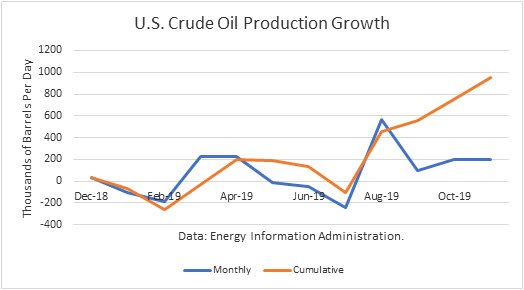
The Energy Information Administration reported that November crude oil production averaged 12.879 million barrels per day (mmbd), up 203,000 b/d from October. In addition, the October estimate was revised 21,000 b/d higher, and so the total gain was 224,000 b/d from the prior estimate.

The Gulf of Mexico rose by 91,000 b/d to 1.995 million barrels per day. Texas production reached a new high of 5.329 mmbd, up 65,000 b/d from October. And New Mexico’s production gained 59,000 b/d to 1.063 million barrels per day.

Plains All American Pipeline LP’s (PAA) Cactus ll pipeline was expected to ship at full capacity, 670,000 b/d, beginning in September. EPIC Midstream’s crude oil pipeline began shipping 400,000 b/d. It is designed to ship 440,000 b/d from the Permian and another 150,000 b/d from the Eagle Ford.

Phillips 66 Partner’s Gray Oak pipeline is expected to ship an additional 900,000 b/d. It began shipments and is expected to be in full service by the end of the first quarter of 2020.
Crude

The gains from last December have amounted 953,000 b/d. And this number only includes crude oil. Other supplies (liquids) that are part of the petroleum supply add to that. For November, that additional gain is about 500,000 b/d. Continue reading "Strong US Crude Production Growth In November"

Coronavirus - ETFs You Should Avoid

With the deadly Coronavirus outbreak continuing to spread and countless US companies let alone Chinese firms suspend business in China, even though the true extent of that effect is yet to be known, it’s clear there is going to be some economic effect from this disease.

Like it or not, we all live in a world that is becoming increasingly more interconnected and interdependent. This is the same reason a disease like Coronavirus is so quick to spread around the world and why the impact on stocks is not going to be limited to those firms based solely in China.

This makes it even more difficult for investors to truly determine what is safe and what isn’t in the stock market right now. However, we do have some low hanging fruit in terms of what you should not own at this time.

The first Exchange Traded Funds you should be avoiding right now are going to be the pure-play Chinese equity ETFs. The iShares MSCI China ETF (MCHI) or the SPDR S&P China ETF (GXC) should be on your sell list or high on the list of what not to buy. These funds invest in Chinese equities and don’t favor one sector more than others. The longer the ‘quarantine’ periods last in the different provinces in China, the more these ETFs are going to be hurt, end of story. However, these could be two outstanding options if you are looking to buy back into the Chinese markets once the Coronavirus scare dies off.

Furthermore, ETFs such as the Continue reading "Coronavirus - ETFs You Should Avoid"

Coronavirus Puts Pressure On Futures

Gold Futures

Gold futures in the April contract is trading higher for the 3rd consecutive session after settling last Friday in New York at 1,578 an ounce while currently trading at 1,591 as prices are right near a 7 year high.

At the current time, I'm not involved, but I do believe higher prices are ahead as there is so much uncertainty about the Coronavirus. If that situation becomes worse, you will see massive money flows continue to enter the bond and gold market. If you are long a futures contract, I would place the stop loss under the 10-day low standing at 1,552 as an exit strategy as prices are trading above their 20 and 100-day moving average telling you that the trend is to the upside.

In my opinion, I believe prices will test the January 8th high of 1,619, possibly in next week's trade. I see no reason to be short gold at this time. Volatility is average, and I think it could start to expand tremendously to the upside, especially if the Coronavirus continues to spread as quickly as it has as. Nobody understands how bad this situation can become, as that will continue to support gold prices in the short-term.

TREND: HIGHER
CHART STRUCTURE: IMPROVING
VOLATILITY: AVERAGE

Platinum Futures

Platinum futures in the April contract settled last Friday in New York at 1,010 an ounce while currently trading at 963. I had been recommending a bullish position over the last month from around the 974 level as it is time to exit as prices are right near a three week low. Continue reading "Coronavirus Puts Pressure On Futures"

Put Spread Options - Defining Risk and Maximizing Returns

As 2020 unfolds and the markets continue to break through record highs, investors should heed these lofty levels. We’re in the longest bull market in history and the U.S. has started and ended a decade without a recession for the first time in history. By nearly all measures, these markets are overvalued with stretched valuations.

Deploying a put spread strategy is a great way to define your risk while leveraging a minimal amount of capital to maximize returns. Whether you have a small account or a large account, a put spread strategy is an effective way to limit risk with a high probability of success. Trading options on stocks like Expedia (EXPE), Tesla (TSLA), Ulta Beauty (ULTA), Apple (AAPL), Disney (DIS), Facebook (FB), etc., that possess such a high price per share when account balances are limited are no longer an issue with put spreads. Put spreads enable you to leverage a minimal amount of capital, which opens the door to trading virtually any stock all while defining your risk.

Over the past 13 months, ~315 trades have been made with a win rate of 86% and a premium capture of 57% across 69 different tickers. When stacked up against the S&P 500, an options strategy generated a return of 9.1% compared to the S&P 500 index which returned 3.7% over the same period. These returns demonstrate the resilience of this high probability options trading in both bear and bull markets. These results can be replicated irrespective of account size when following the fundamentals outlined below.

Put Spread and Defining Risk

Options can be used in a leveraged manner hence using small amounts of capital to trade what otherwise would require much greater capital requirements. A put spread is a type of options trade that risk-defines your trades and involves selling and buying an option. Let’s review a put spread below.

The Put Spread: Continue reading "Put Spread Options - Defining Risk and Maximizing Returns"

Market Falls On Weak Data And Virus Fears

The first trading month of 2020 is closing out with a thud. For the second time this week, the DOW has fallen over 500 points, triggering a new red weekly Trade Triangle indicating that a move to a sidelines position may be in order. To add to that, with today's losses, the DOW is having its worst day since Oct. 2nd and has erased its monthly gains booking its first January loss since 2016, standing at -.6%.

As we head into afternoon trading, the DOW and S&P 500 will post a weekly loss of over -2%. However, The S&P 500 will try to hang on to a monthly gain of .+1%. The NASDAQ will lose over -1.5% on the week but will hang onto a monthly increase of +2.3%.

Manufacturing activity in the Midwest sank in January to the lowest level since December 2015, according to a survey of businesses released Friday by MNI Indicators. The Chicago Purchasing Managers Index (PMI) fell to 42.9 this month from 48.9 in December. Any reading below 50 indicates deteriorating conditions. Economists surveyed by Econoday had expected a small dip to 48.5. Continue reading "Market Falls On Weak Data And Virus Fears"