Sell In May? Wait For The Powell Put

After turning in one of its best January-April performances in more than 20 years, the stock market has suddenly run out of gas in May. We’re nowhere near correction territory – the S&P 500 is down about 2% so far this month after climbing more than 18% in the first four months of the year, and up 22% since the Christmas Eve bottom. Yet the financial press has been filled with “sell in May and go away” stories, citing the Wall Street urban legend – or historical trend, take your pick – that all the money that’s going to be made this year has already been made, so you may as well cash in your winnings and sit out the rest of the year.

The major impetus behind the dip – which doesn’t even meet the definition of a “dip” yet since few people seem to be buying on it – is President Trump’s announcement that he has upped the ante on the trade war with China, raising worries that talks between the two countries will collapse. The recent spate of high-profile IPOs from Lyft, Uber, Pinterest and other companies is also signaling that the stock market may have peaked.

Which raises the question: Is the Powell Put going to come to the stock market’s rescue again in the near future? How deep will a drop in the stock market – assuming it keeps dropping – have to get before the Federal Reserve intervenes and cuts the federal funds rate? Continue reading "Sell In May? Wait For The Powell Put"
Gold Update: Calm Before Storm?

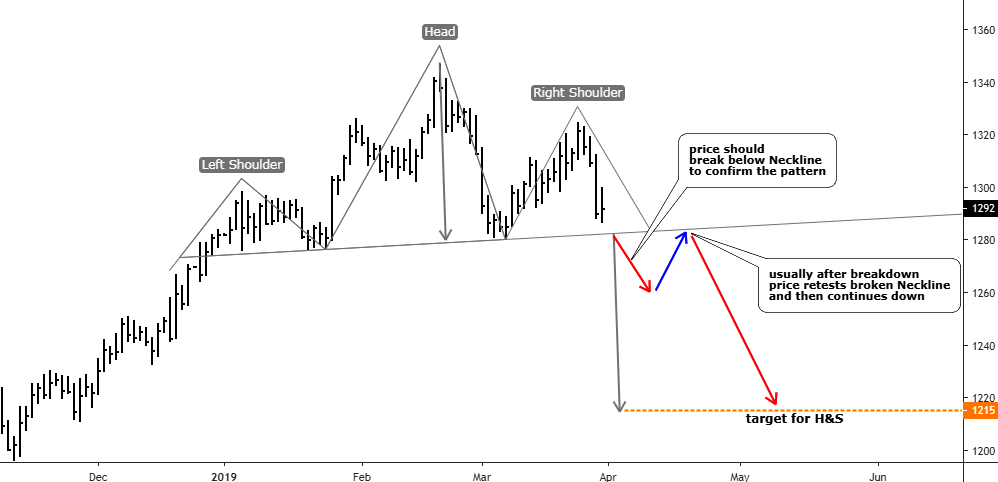
Last month I spotted the reversal Head & Shoulders pattern on the daily gold chart and shared it with you. Let’s see how it played out.

I entered the replay mode on the chart below and deleted the bars that appeared after the previous post to show you what I was expecting from the Head & Shoulders pattern. I would like to add more educational annotations for you in this post.

Head & Shoulders pattern
Chart courtesy of tradingview.com

The previous annotations were switched to gray except the target level for the Head & Shoulders pattern. So, what I was expecting to appear on the chart? First of all, there should be a breakdown below the Neckline, which would confirm the pattern (short red down arrow). Usually, after the breakdown, the price retests broken Neckline (blue up arrow). Only then, the market continues its move in the direction of a target (long red down arrow). Continue reading "Gold Update: Calm Before Storm?"

World Oil Supply And Price Outlook, May 2019

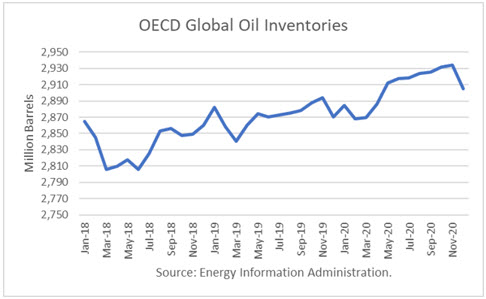
The Energy Information Administration released its Short-Term Energy Outlook for May, and it shows that OECD oil inventories likely bottomed last June at 2.806 billion barrels. It estimated that stocks rose by 20 million barrels in April to 2.860 billion, 51 million barrels higher than a year ago.

Throughout the balance of 2019, OECD inventories are expected to rise modestly. At year-end, EIA projects stocks at 2.870 million barrels, 11 million more than at the end of 2018.

For 2020, EIA projects that stocks will build another 35 million barrels to end the year at 2.905 billion. The non-extension of waivers to Iran’s sanctions implies lower OPEC output for the period, and this factor has lowered the EIA’s stock forecast materially.

oecd oil inventories

Oil Price Implications

I updated my linear regression between OECD oil inventories and WTI crude oil prices for the period 2010 through 2018. As expected, there are periods where the price deviates greatly from the regression model. But overall, the model provides a reasonably high r-square result of 80 percent. Continue reading "World Oil Supply And Price Outlook, May 2019"

Weekly Futures Recap With Mike Seery

Copper Futures

The highly anticipated trade agreement with China has failed at this time as the U.S has added more tariffs which were supposed to send shockwaves throughout many of the commodity sectors, but it fizzled big time as there are very few major reactions in today's trade. Copper prices are currently trading at 2.7680 a pound after settling last Friday in New York at 2.8190 down about 300 points continuing its bearish momentum as prices are trading right near a 14 week low. I have been recommending a bearish position from around the 2.8240 level & if you took the trade continue to place the stop loss above the 2 week high which remains at 2.9235, however in next week's trade the stop loss will be lower therefor the monetary risk will also be reduced. Copper prices are still trading below their 20 and 100-day moving average as clearly the trend is to the downside. However, we keep bouncing off of major support around the 2.75 level as that has to be broken on a closing basis to continue the bearish momentum as I still believe we can test the contract low around 2.56 in the coming weeks ahead so stay short.
TREND: LOWER
CHART STRUCTURE: IMPROVING
VOLATILITY: HIGH

S&P 500 Futures

The S&P 500 in the June contract settled last Friday in Chicago at 2947 while currently trading at 2853 down almost a 100 points for the trading week hitting a 6 week low all because there is no trade agreement between the United States and China. If you had followed any of my previous blogs you understand that I've been bullish the stock market forever, but this is why you need an exit strategy as the 2 week low was at 2890 as that's where you should have been stopped out if you had a bullish position as prices have dropped rather dramatically. When you trade the commodity markets buying and never getting out is not the way to trade as you must have some type of strategy to exit as mine is if prices hit a 2 week low it's time to move on. The S&P 500 is now trading below its 20 but still above its 100-day moving average as the volatility certainly has increased and that's going to remain the same until we find out more about this trade agreement. The next major level of support is down at the 2800 area & if that is broken, then a bearish trend could develop. However, I still have a bullish bias towards the stock market as the U.S economy is outstanding coupled with the fact of strong corporate growth. However, I am currently sitting on the sidelines as the risk/reward is not in your favor.
TREND: MIXED
CHART STRUCTURE: POOR
VOLATILITY: HIGH

Continue reading "Weekly Futures Recap With Mike Seery"

7 Essentials For Effective Options Trading

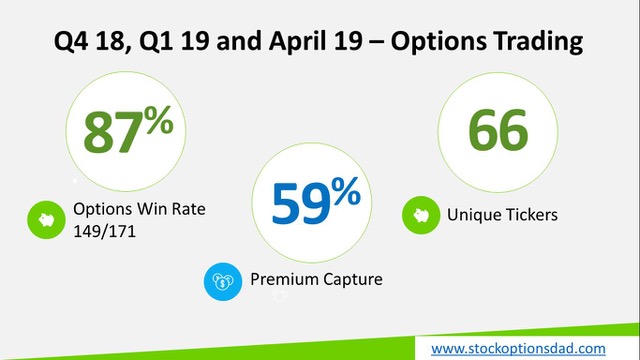
I’ll be discussing a comprehensive options strategy and key fundamentals for long-term successful options trading. These essentials will enable your portfolio to appreciate steadily month after month for consistent portfolio appreciation. Since options are a bet on where stocks won’t go, not where they will go, this is accomplished without predicting which way the market will move. These fundamentals provide long-term durable high-probability win rates to generate consistent income while mitigating drastic market moves. Following these option trading essentials, I’ve demonstrated an 87% options win rate over the previous 7 months through both bull and bear markets while outperforming the S&P 500 over the same period by a wide margin producing a 6.4% return against a 1.0% for the S&P 500.

Empirical Application

Applying these 7 essentials, long-term options trading success can be achieved to generate consistent income and mitigate risk in a high-probability manner. I was able to win 87% of my options trades while capturing 59% of premium income (Figure 1). This was achieved by trading options in a diversity of tickers for a total of 66 stock and ETFs. These essentials resulted in a wide outperformance relative to the S&P 500, posting a 6.4% return compared to a 1% return for the S&P 500 (Figure 2).

Options Trading
Figure 1 – Metrics across the options based strategy over the previous 7 months Continue reading "7 Essentials For Effective Options Trading"