Weekly Futures Recap With Mike Seery

We've asked Michael Seery of SEERYFUTURES.COM to give our INO readers a weekly recap of the Futures market. He has been Senior Analyst for close to 15 years and has extensive knowledge of all of the commodity and option markets.

Michael frequently appears on multiple business networks including Bloomberg news, Fox Business, CNBC Worldwide, CNN Business, and Bloomberg TV. He is also a guest on First Business, which is a national and internationally syndicated business show.

Gold Futures

Gold futures in the June contract settled last Friday at 1,251 an ounce while currently trading at 1,247 in a very nonvolatile trading week right near major resistance as prices are still trading above their 20 and 100-day moving average telling you the short-term trend is higher. At present, I am not, involved in the precious metals as the U.S dollar continues to flip-flop which had made the commodity markets basically go sideways over the last several months. For the gold rally to continue in my opinion prices, have to break major resistance around 1,268 which is still about $20 away as the U.S stock market continues to hover near all-time highs which generally is a negative towards gold prices. Gold prices bottomed out last month around the 1,200 level as that's when the Federal Reserve stated that they might slow down on raising interest rates sending prices back up towards the upper end of the trading range, however prices still remain choppy over the last several months so wait for a true trend to develop as there are very few markets that have strong trends at the current time.
TREND: MIXED - HIGHER
CHART STRUCTURE: IMPROVING

Continue reading "Weekly Futures Recap With Mike Seery"

U.S. Crude Oil Exports Could Mean Stocks Are Dropping Elsewhere

Robert Boslego - INO.com Contributor - Energies


Crude stocks built by 0.9 million barrels in the week ending March 24th to end at 534 million barrels, 30.2 million larger than a year ago, setting a new record high. But crude oil exports also surged to 1.010 million barrels per day.

The stated objective of the OPEC production cut is to reduce OECD global inventories back to their five-year average. The U.S. has the largest excess inventories of any OECD country, and also publishes the most transparent, timely data, and so I had expected OPEC to target reductions in its exports to the U.S.

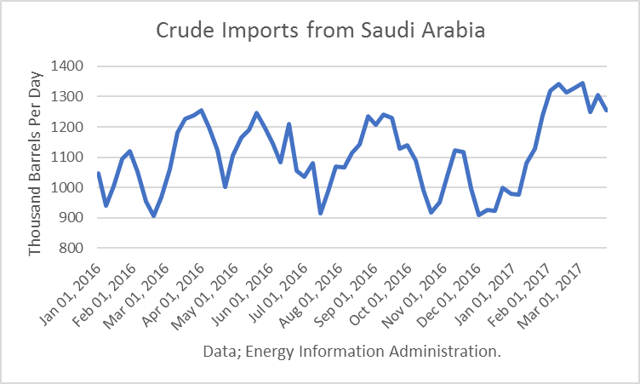
But based on Energy Department statistics for the weeks ending March 24, 2017, U.S. crude imports from Saudi Arabia averaged about 1.240 million barrels per day in the year-to-date. Saudi Arabia is the second largest source of imports behind Canada. That figure was about 30% higher than in the same weeks last year, and about 17% higher than during December, before its production cuts went into effect.

Crude Imports From Saudi Arabia

The Saudi energy minister claimed in December that he was reducing tanker nominations effective January 1, 2017, Saudi exports to the U.S. are 178,000 b/d higher than a year ago. Based on the import numbers for the 12 weeks off 2017, there is no evidence of any Saudi production cut. Continue reading "U.S. Crude Oil Exports Could Mean Stocks Are Dropping Elsewhere"

The End Of A Stellar Quarter For Stocks

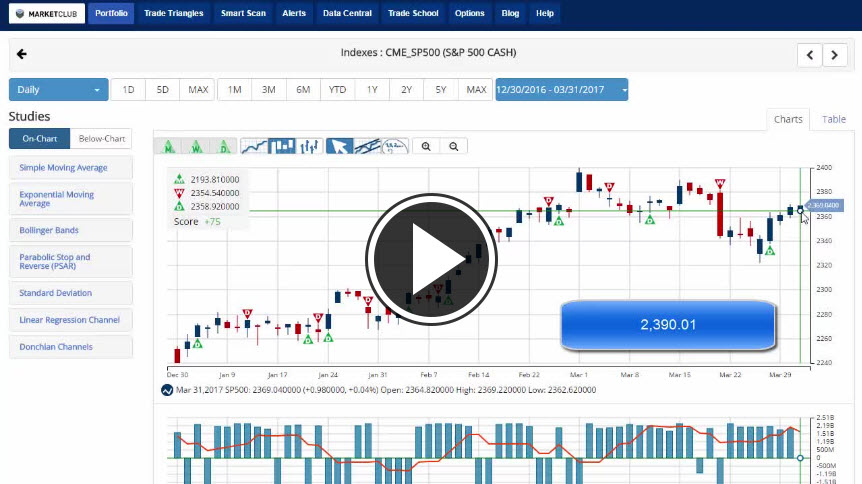
Hello MarketClub members everywhere. Let's take a look at the stellar quarter that was for stocks and the indices. The Dow will finish the quarter up +4.7%, the S&P 500 +5.7% and the NASDAQ with the biggest gain standing at +10% followed closely by gold, which ended with a gain of +8%.

The two markets that suffered and failed to make gains were the U.S. Dollar which lost -2% and of course crude oil, which dropped -9% for the quarter.

MarketClub's Mid-day Market Report

A trade that I've highlighted a few times this quarter is Alibaba Group Holding Limited (NYSE:BABA). The Trade Triangle got long based on a new green monthly Trade Triangle on 2/22/17 and had a positive gain of +3.5% for the quarter.

Key levels to watch this week: Continue reading "The End Of A Stellar Quarter For Stocks"

Why Is The Federal Reserve Not Selling?

Lior Alkalay - INO.com Contributor


On March 15th, the Federal Reserve Chairman, Janet Yellen, announced that the Fed would raise its target rate to 0.75-1.00% from 0.5-0.75%. Yellen also stressed, in a clear, hawkish tone, that the United States economy is doing well. After roughly three months of “hints” embedded in the Fed’s many statements, that news was hardly a surprise.

But in the same speech, Yellen stressed that the Fed was not ready to start selling the $4.5 trillion in the Treasury Notes, Treasury Bonds and mortgage papers that it holds on its balance sheet. Instead, Yellen stressed that the Fed sees rate hikes as the monetary tool. Further, rate hikes, as a tightening measure, must first be exhausted before the Fed would start selling those trillions. That was a clear retreat from the hints the Fed had dropped in the weeks which followed President Trump’s inauguration.

In fact, one could go so far as to say Yellen’s rhetoric, with respect to the Fed’s balance sheet, has been dovish; the way Yellen specifically emphasized how cautious the Fed is about the prospect of trimming its balance sheet singled that option out as some kind of a “bomb” that the Fed doesn't really want to drop and which could send markets into panic mode. If, indeed, the US economy doing so well, why then is the Fed not ready to roll back Quantitative Easing, a stimulus measure generally considered life support for the banking system? Continue reading "Why Is The Federal Reserve Not Selling?"

Issue #13: Icahn's Bristol-Myers Stake, Biotech Cohort Rallies and Eli Lilly's CEO Speaks

INO Health & Biotech Stock Guide

Issue #13

BIOTECH, HEALTH & PHARMA NEWS

Ever since President Trump met with a group of pharmaceutical executives at the White House, the entire biotech cohort has witnessed a resurgence as of late. This meeting was perceived as a positive interaction between the nascent government and the industry on a whole. This coincides with a consortium of big pharma companies joining forces to address transparency on drug price increases. Allergan (AGN), J&J (JNJ), Novo Nordisk (NVO), Merck (MRK) and AbbVie (ABBV) have committed to limiting any annual drug pricing increases to less than 10%. J&J, AbbVie and Merck all published annual reports regarding its portfolio and the price increases they’ve implemented. This transparency coalition is a step in the right direction to appease the general public and governmental officials that have been very critical of drug price increases. To add icing on the cake, Amgen’s CEO stated “We look forward to working collaboratively with the new administration.” Pharmaceutical executives are being proactive to be part of the conversation and be present at the table when it comes to working with Trump and his hardline stance regarding jobs and drug prices. The collaborative approach will hopefully bode well for the industry as a healthy relationship is fostered perceived on Wall Street.

Continue reading "Issue #13: Icahn's Bristol-Myers Stake, Biotech Cohort Rallies and Eli Lilly's CEO Speaks"