Pendulum Experiment No.2: Another Success! Let’s Push It Again!

Aibek Burabayev - INO.com Contributor - Metals


This is the summary of the second experiment that I started in the middle of 2016 where we put the ultimate loser – the stock index of struggling Japanese economy against the top gaining favorite metal – silver.

Chart 1. Voting results July 2016: The Majority Bet Against The Success Of Experiment!
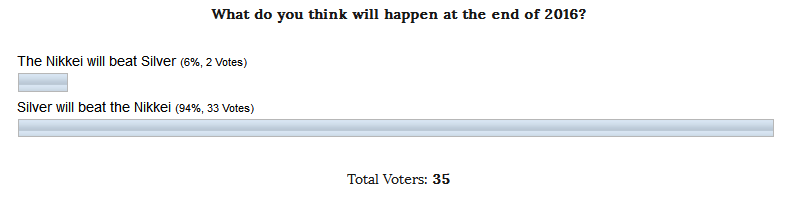
INO.com Poll Silver vs. Nikkei

Above is the result of the voting for these totally different instruments from 6 months ago. This time, congratulations are only to me as an experimenter as I voted for the Nikkei (every time I vote for experiment success, not for an individual instrument) and to another single person (total two votes for the Nikkei), who went against the majority. If you are reading this post please write your name in the comment, let the community meet you.

I think, this time, the majority was ultra-biased and bet on silver. I am afraid to imagine what would be the voting results if gold was the among bets 🙂 Previously, the votes split almost even with a minimal advantage in favor of palladium.

Chart 2. Nikkei Vs. Silver: The Worst Performing Japanese Stock Index Defeated The Top Gaining Metal
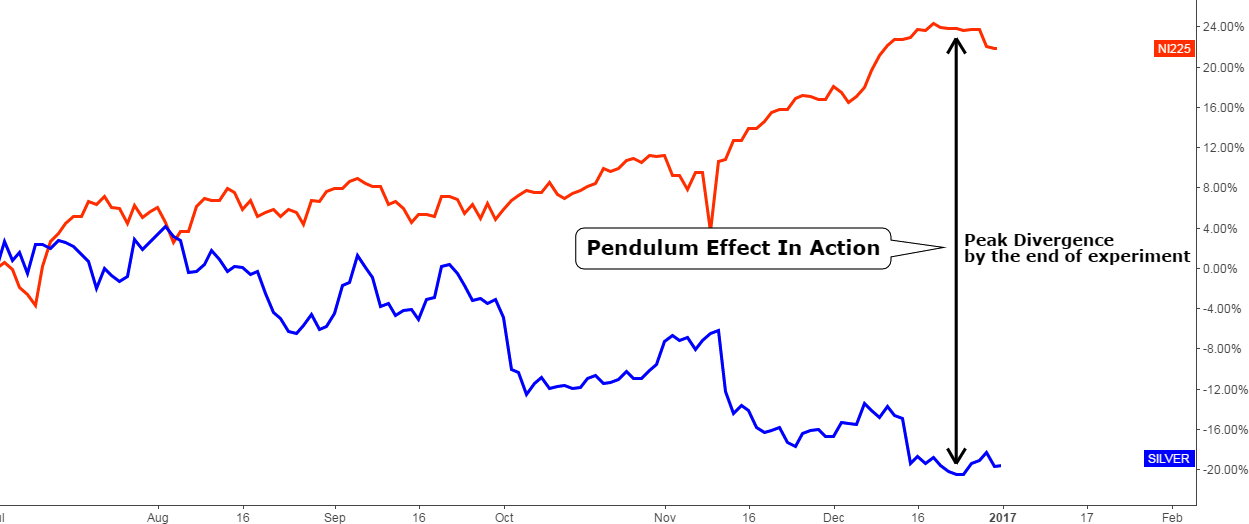
Chart 2. Nikkei Vs. Silver
Chart courtesy of tradingview.com

I think we witnessed the maximum divergence at 22% between these two instruments when I posted a snapshot of the experiment last October. But the final outcome is just astonishing! The Nikkei hit above the +20% handle while the silver also hit the 20% mark but with a minus sign. It is easy to calculate that the divergence peaked above the 40% mark. It means that for the past half year those who sold the silver and bought the Nikkei could book more than 40% of the trade in 6 months.

This is the second straight success of an experiment! I think it was lucky to choose that very period of 6 months for an experiment during which the Pendulum Effect of the market has enough time to take action. And another amazing regularity, which is clearly seen on the chart: the maximum divergence of instruments at the end of an experiment.

Let’s push the Pendulum again to have more records for more reliability.

Chart 3. Comparative Histogram Half Year Futures Performance (January 3rd, 2017)
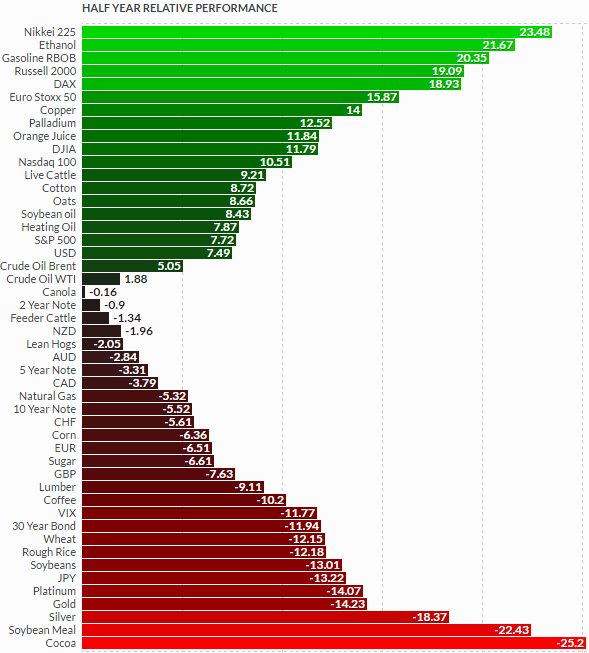
Chart 3. Comparative Histogram Half Year Futures Performance (January 3rd, 2017)
Chart courtesy of finviz.com

It looks like the Nikkei is the futures’ superstar for the past half year as it beat not only silver, but all the rest of the futures and topped the ranking. It transformed from the “complete non-entity” into a “superhero” just in 6 months amid the Bank of Japan’s asset purchases.

Silver finished 3rd from the end of the list and showed the worst performance among metals in the second half of 2016.

It is ridiculous, but we should put them against each other again in a new Pendulum experiment. Please vote at the end of the post for one of these instruments to show me your preference.
I already posted the fresh silver chart last month and this time I will update the Nikkei chart which was posted last October.

Chart 4. Nikkei Weekly: Magic 78.6%
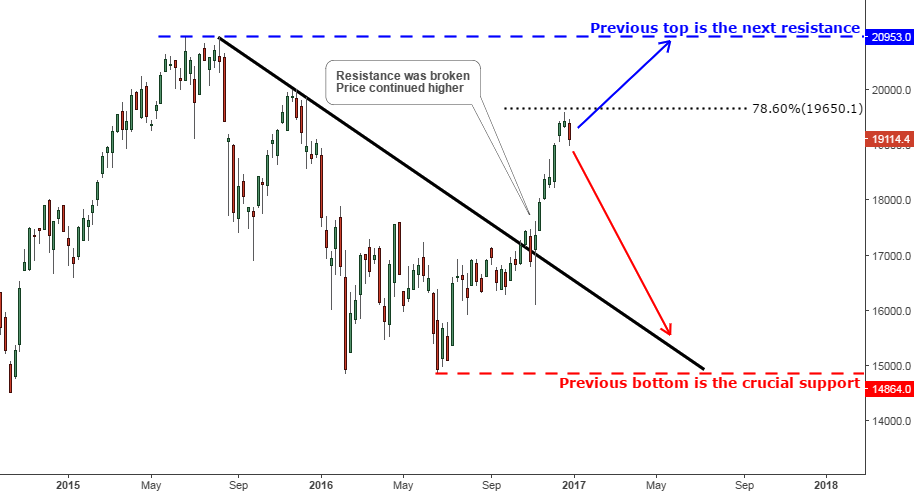
Chart 4. Nikkei Weekly w/Fibonacci
Chart courtesy of tradingview.com

The Nikkei index is in the giant range set by the 2015 top at ¥20953 and the 2016 bottom at ¥14864. This instrument is very good for positioning as it moves actively like a shark, which needs to move steadily to breathe and stay alive.

Last October we witnessed a breakup of the resistance (black), after that we can see that the price continued higher in the direction of the break. Price rocketed ¥17k to ¥19k level, but then it stalled ahead of 78.6% Fibonacci retracement level set at ¥19650 mark. The index has lost more than a half thousand already after reversal. This setback can start another drop down to the broken resistance at least or even lower to the range’s bottom highlighted in-dash red horizontal line. The break above the 78.6% Fibonacci level opens the way to the previous top at ¥20953.The risk/reward ratio favors short entry as resistance is closer than the support.

What do you think will happen in the middle of 2017?

View Results

Loading ... Loading ...

Intelligent trades!

Aibek Burabayev
INO.com Contributor, Metals

Disclosure: This contributor has no positions in any stocks mentioned in this article. This article is the opinion of the contributor themselves. The above is a matter of opinion provided for general information purposes only and is not intended as investment advice. This contributor is not receiving compensation (other than from INO.com) for their opinion.


Weekly Futures Recap With Mike Seery

We've asked Michael Seery of SEERYFUTURES.COM to give our INO readers a weekly recap of the Futures market. He has been Senior Analyst for close to 15 years and has extensive knowledge of all of the commodity and option markets.

Michael frequently appears on multiple business networks including Bloomberg news, Fox Business, CNBC Worldwide, CNN Business, and Bloomberg TV. He is also a guest on First Business, which is a national and internationally syndicated business show.

Gold Futures

Gold futures in the February contract settled last Friday in New York at 1,151 an ounce while currently trading at 1,177 up about $26 for the trading week as I have been sitting on the sideline's in this market for several months as a possible bottom now may have been formed. The chart structure is poor at present as the 10-day low stands at 1,129 as the monetary risk is way too high to enter at this point so keep a close eye on this market on any type of price retracement & a couple more days off the calendar then we could be entering a possible bullish position as I do think the commodity markets will move higher in 2017. Gold prices are now trading above their 20-day but still far below their 100-day moving average has this has been a longer-term bearish trend for several years as the U.S dollar is still hovering right near 14 year high as that is the main culprit to the precious metals in recent history coupled with the fact of a very strong U.S stock market continuing to take money out of the precious metals and into other sectors. Continue reading "Weekly Futures Recap With Mike Seery"

ETFs to Buy, to Sell, and to Watch in 2017

Matt Thalman - INO.com Contributor - ETFs


Now that we have rung in the New Year, now is a good time to take a look at your portfolio and make some adjustments. But, before you start buying and selling, you need to know what to buy, what to sell and what you should have on hold.

So with that in mind, let's take a look at a few Exchange Traded Funds you may want to buy, a few you should sell, and a couple that you should have in your hold or watch list.

What To Buy

In 2016 one of the top-performing ETFs was the Direxion Daily Regional Banks Bull 3X Shares (PACF:DPST). DPST rose more than 114% in 2016 due to its exposure to regional banking stocks, and of course is three times bullish leverage. And while most of the time I would tell you not to follow a trend from one year to the next, 2017 is going to be different. The banking stocks rose in 2016 for a number of reasons, but mainly because the economy grew stronger and interest rates rose.

There are no signs at this point indicating that neither of those trends will cease to continue in 2017, so ride this trend.

Ok, let's slow down and understand why this trend will continue to work. Continue reading "ETFs to Buy, to Sell, and to Watch in 2017"

Here Comes U.S. Shale Oil, Saudi Arabia

Robert Boslego - INO.com Contributor - Energies


In a press conference following OPEC's meeting with non-OPEC producers earlier in the month, Saudi Minister Khalid A. Al-Falih said he did not expect an American shale production response in 2017 because there are significant lags in restarting production. But I thought that shale oil 'Zombies' might get a new life sooner than he expected.

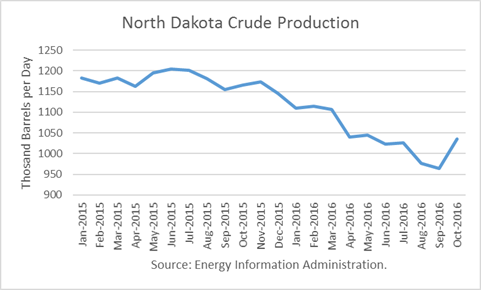
Data from the Energy Information Administration (EIA) confirmed that production in North Dakota rebounded 7% in October. And EIA projects shale oil production will gain another 74,000 b/d in January.

North Dakota Crude Production

Petroleum Supply Monthly (PSM)

The EIA reported that actual crude production for October averaged 8.807 million barrels per day (mmbd). This was an increase of 232,000 b/d from September, which had been the lowest level (8.575 mmbd) from the peak in April 2015 of 9.627 mmbd. Continue reading "Here Comes U.S. Shale Oil, Saudi Arabia"

Will Brazil Turn A Corner In 2017?

Lior Alkalay - INO.com Contributor


In Brazil, the year 2016 will no doubt go down in the history books as one of the worst the country has experienced. The Brazilian president, Dilma Rousseff, was impeached for the role they played in a bribery scandal and for illegally disguising the country’s real debt. Moreover, the Brazilian economy had its worst recession in more than half a century.

And yet, there are some encouraging signs that, at least as far as the economy and the Brazilian Real are concerned, the country might have turned a corner.

Brazilian Bonds Revival

In the months of January and February, when the political climate turned more and more chaotic and Brazilian growth tumbled, yields on Brazilian 10-year bonds were as high as 16.78% and CDS prices, which measure the likelihood of a sovereign debt default, jumped to 7%. One would then expect that, from this point onwards, and especially in recent months with the prospect of a Fed’s tightening weighing on bond markets across the globe, the already fragile Brazilian government bonds would experience an utter meltdown, even to the extent of risking an actual default. But what happened instead was interesting. While bonds across the world were tanking and yields surging (bond yields move in reverse, relative to prices) amid the Fed’s tightening, Brazilian bonds staged an impressive rally, and yields on 10-year bonds fell from their highs back in January to as low as 11.4% today. Unsurprisingly, this was followed by an impressive rebound for the Brazilian Real. Continue reading "Will Brazil Turn A Corner In 2017?"