Summer Weather Impacts Futures

Corn Futures

Corn futures in the December contract settled last Friday in Chicago at 3.53 a bushel while currently trading at 3.54 unchanged as traders are awaiting the WASDE crop report with estimates around 2.683 billion bushels as the carryover level. Any number below that number will be construed as bullish. In contrast, any amount higher than that number would be construed as bearish as the weather will now be the short-term dictator of price action. The 7-10 day weather forecast still has above-average temperatures. However, the crop at the current time has estimates around 71% good/excellent condition.

I am not involved as I do have a bullish soybean recommendation.
However, if you are long a futures contract, I would place the stop loss under the contract low standing at 3.22 as an exit strategy. I'm keeping a close eye on this market for a bullish position as I want the chart structure to improve, and that will take another couple of days or a replacement in price.

Corn prices are still trading above their 20 and 100 a moving average as the trend is higher as prices are still hovering right near a 3 month high with the next major level of resistance at the 3.60 area and if that is broken, I think we can head up to the $4 level as I see no reason to be short.

TREND: HIGHER
CHART STRUCTURE: IMPROVING
VOLATILITY: HIGH

Soybean Futures

Soybean futures in the November contract settled last Friday in Chicago at 8.96 a bushel while currently trading at 9.01, basically unchanged for the week. I have been recommending a bullish position from around the 8.97 level. If you took that trade, continue to place the stop loss at 8.56 as an exit strategy as the chart structure will improve early in next week's trade, therefore lowering the monetary risk. Traders are awaiting this afternoon's WASDE crop report with estimates around 414 million bushel carryover as that report will certainly send volatility back into this market. Continue reading "Summer Weather Impacts Futures"
S&P 500 Sends Bullish Signal

The S&P 500 just sent what most traders view as a bullish signal, what is it you ask? A golden cross, which is often seen as a bullish indicator signaling that a significant move higher could follow.

So, precisely what is the golden cross. A golden cross is when the 50-day Simple Moving Average (SMA) crosses above the longer-term 200-day SMA.

When a short-term simple moving average crosses over a long-term one, it's often a signal that bullish momentum is ramping for the stock. Because long-term simple moving averages take a lot more time to influence, traders can use this to calculate a stock's relative strength. The higher the time period used, the stronger and longer-lasting the breakout tends to be.

All three major indexes will end the week in positive territory with the Continue reading "S&P 500 Sends Bullish Signal"

"Diamond" Pattern Pushed Gold To Sky Vs. Silver

I appreciate active readers of the Blog for leaving valuable comments on Gold and Silver posts. Recently, there have been a lot of thoughts shared not only about the metals itself but also about its relationship reflected in the dynamics of the Gold/Silver ratio. I think it’s time to talk about it in this post. Please feel free to enrich this piece with your valuable thoughts in the comments section.

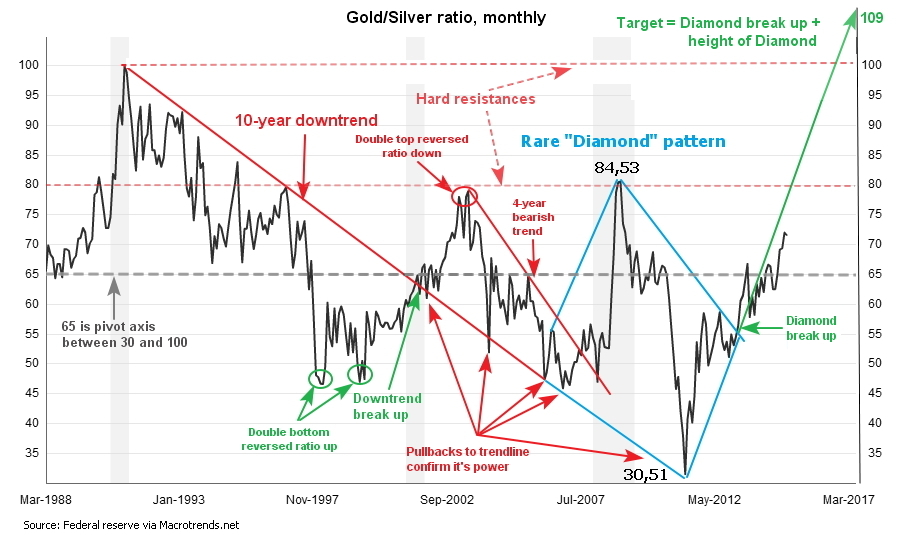
Back in December 2014, I shared only the third post here on the Blog. The title was more appropriate for a science fiction novel as it promised the “journey to the Moon” for the Gold/Silver ratio as it was going to hit the 109 ounces. Below is that very chart from the distant 2014 to refresh the memory.

gold silver

The idea was based on the “Diamond” pattern spotted on the monthly chart (blue). The target was reached more than five years later on the 16th of March this year. The total gain is equal to 109 - 72 = 37 troy ounces of silver per troy ounce of gold or 51% in five years.

Let’s see in the weekly chart below the ratio dynamics after that post. Continue reading ""Diamond" Pattern Pushed Gold To Sky Vs. Silver"

U.S. Crude Oil Production Fell Sharply In April

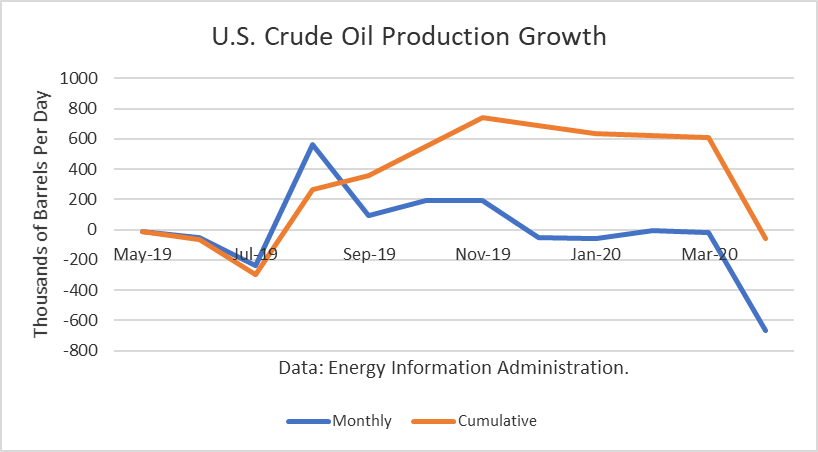
The Energy Information Administration reported that April crude oil production averaged 12.061 million barrels per day (mmbd), down 669,000 b/d from March. Reductions were largest in Texas (234,000) and North Dakota (195,000).

Crude Oil

Given the large reduction in April, crude oil production dropped by 62,000 b/d over the past 12 months. This number only includes crude oil. Other supplies (liquids) that are part of the petroleum supply fell by an additional 560,000 b/d from a year ago. Continue reading "U.S. Crude Oil Production Fell Sharply In April"

Facebook Boycott: Here We Go Again

If the Cambridge Analytica fiasco, one mishandled public relations incident after another and numerous earnings calls that went down as some of the biggest blunders in history wasn’t enough, now enter an international advertising boycott. Here we go again, Facebook (FB) investors have been through a lot over the past two years. Now another challenge is confronting the company via an advertising boycott that’s growing into the hundreds of multinational companies. This challenge may weigh heavier on the company since this boycott will directly impact revenue as expenses swell. The magnitude of this boycott will inevitably influence the stock price as this movement grows in numbers and duration. If Facebook can appease advertisers in a timely fashion, then this may be a temporary challenge. However, as advertising spending is abandoned indefinitely due to this boycott and overall spend slows due to COVID-19, this culmination could cast uncertainty around its stock valuation. Thus far, over 400-plus brands have fled Facebook.

Boycott Growing In Numbers and Duration

International household names such as Adidas, Best Buy (BBY), Clorox (CLX), Ford (F), HP (HPQ), Starbucks (SBUX), Coca-Cola (KO), and Verizon (VZ) have joined the advertising boycott across Facebook and its platforms. Companies are jumping on the bandwagon daily, including a significant recent addition of Microsoft (MSFT). Total advertisers that have abandoned Facebook and its Instagram properties have now ballooned to over 400 organizations. With an undefined timeframe of how long these advertisers will stay away from Facebook may dampen revenue expectations. Another complexity that may arise is the ability to appease the collective group of advertisers in order to bring all of these companies back to the platform. Continue reading "Facebook Boycott: Here We Go Again"