Worst Performing ETFs in 2019

Earlier in the month, we discussed the Top Performing ETFs of 2019. In this post, we'll discuss the worst performing ETFs of 2019.

After a down year in 2018, the stock market roared back in 2019 despite a number of political headwinds and many market participants calling for a recession to commence during the second half of the year. Fortunately, that never happened and the market shrugged off most of the negative headlines throughout the year since for the most part, economic numbers remained strong and while corporate earnings and revenue growth may be slowing, they are still in positive territory, which is undoubtedly a good sign.

With the S&P 500 (SP500) ending the year up 28.9%, the Dow Jones Industrial Average (DJI) rose 22.3%, and the NASDAQ (COMP) increased by 35.2% in 2019, one may wonder how anyone could have lost money in 2019, but unfortunately, some Exchange Traded Funds and therefore investor, did actually see negative returns during a year when the major indexes all crushed it.

Most investors who ended the year negative may want to forget about what happened. But those investors who focus on understanding why their investments went south are the ones who will learn from their mistakes and hopefully avoid making them in the future. The start of a new year is an excellent time to review your investing thesis and try to pinpoint why some investments didn’t turn out the way you imagined they would. So let’s take a look at the top five worst performing ETFs of 2019 in a number of different categories the average investor had to choose from in 2019 to see if you owned one or more of them.

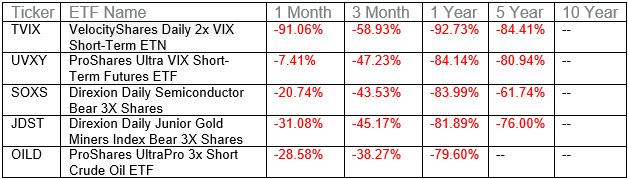
The following table shows the performance of the worst five ETFs in 2019, as well as their performance over the last month, the previous three months, the last five and ten years.
ETFs

The following table shows the performance of the worst five Non-Leveraged ETFs in 2019, as well as their performance over the last month, the previous three months, the last five and ten years. Continue reading "Worst Performing ETFs in 2019"
Visualizing Correlation: Gold Vs. Other Instruments

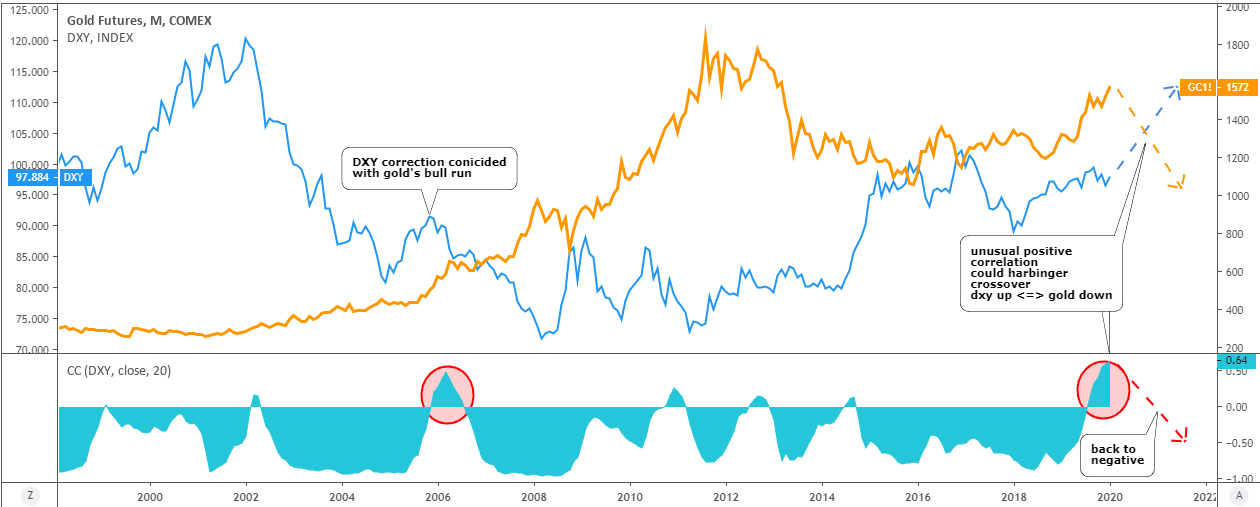
Some of our regular readers kindly shared their opinion about the gold market correlation with other instruments in the comments section under my previous post. I think it could be interesting for all of us to see what is going on there if we check the correlation between gold and other instruments.

I prepared the visualization of it for you below. The dollar index and the 5-year TIPS (Treasury Inflation-Protected Securities) were named in the comments, and I will add two other top instruments, so please stay tuned.

Let’s start with the Dollar Index (DXY).

Correlation
DXY: blue, left scale / Gold: orange, right scale / Correlation coefficient: turquoise, sub-chart - Chart courtesy of tradingview.com

For more than 20 years, these two instruments were mostly in a negative/mirrored correlation. It just changes from extremely negative to zero correlation with rare spikes into positive territory. Continue reading "Visualizing Correlation: Gold Vs. Other Instruments"

Stocks Tumble On Coronavirus Fears

A broad-based market sell-off has been the theme of the day to start the week. The reason for the sell-off? The Coronavirus, there are 2,862 confirmed cases so far in China, and the death toll in China has risen to 81. The World Health Organization's director-general is traveling to China to meet with government and health officials. In the U.S., the fifth case of coronavirus was confirmed over the weekend.

The DOW fell over 500 points, and one point or -1.6% at the open and has continued to trade at those levels, the S&P 500 dropped -1.4%, and the NASDAQ has lost -1.8%. All three indexes were poised for their worst day since October. Continue reading "Stocks Tumble On Coronavirus Fears"

Bullish Momentum Continues For Futures

S&P 500 Futures

The S&P 500 in the March futures contract is currently trading at 3332 after settling last Friday in Chicago at 3325 continuing its bullish momentum to the upside despite fears of the Coronavirus spreading affecting global growth.

The S&P 500 is trading higher for the 3rd consecutive session, hitting another all-time high this week, and if you are long a futures contract place the stop loss under the 2 week low which now stands at 3260. The chart structure will improve next week, therefore, lowering risk as this gravy train continues to the upside as earnings have been very solid.

I see absolutely no reason to try to pick a top and get short this market. If you have been following any of my previous blogs, you understand that I think 2020 will be a good year for the stock market as January is off to an excellent start, up about 4%.

The S&P 500 is trading far above its 20 and 100-day moving average as this is one of the strongest trends to the upside. That is why trading with the path of least resistance is the most successful way to trade over time as picking tops or bottoms is extremely difficult and fruitless, in my opinion.

TREND: HIGHER
CHART STRUCTURE: SOLID
VOLATILITY: AVERAGE

Platinum Futures

Platinum futures in the April contract are ending the week on a positive note up $10 at 1,017 after settling last Friday at 1,024 in New York down slightly for the trading week still consolidating the recent run-up that we have experienced over the previous couple of months. Continue reading "Bullish Momentum Continues For Futures"

The Market Says AMC Is Worthless - I Disagree

The market has rendered AMC Entertainment (AMC) a worthless company. The stock has nosedived from a 52-week high of $17 to $6.50 per share, resulting in a 62% reduction in market capitalization. Even worse, AMC was $33 per share in 2017 resulting in a multi-year meltdown of 80%. The catastrophic stock collapse has occurred in the backdrop of record numbers at the domestic and worldwide box office. There’s a paradoxical disconnect between the record multi-year box office stretch and AMC’s stock price.

AMC recently posted a strong quarter and has diversified its revenue stream by rolling out its own loyalty program that now has over 900,000 members to evolve a large segment of its business mix towards a subscription-based model to smooth out box office revenue fluctuations. This will allow durable and more predictable revenue streams in the backdrop of changing box office dynamics. AMC recently posted a record third-quarter attendance in the U.S. and international markets along with strong Q3 numbers. At current levels, the stock sports a hefty dividend yield of ~11% due to the decimated stock price.

Streaming threats from the likes of Netflix (NFLX), excessive debt load, bleak 2020 movie slate while being one of the most heavily shorted stocks (~60% of the float being sold short) has decimated the shares of AMC. I feel that AMC has significant upside considering its depressed valuation, improving financials, upcoming deleveraging, and creative initiatives to drive revenue growth.

Record Q3 2019 Numbers

First, AMC has been firing on all segments of its business on improving fundamentals across the entire enterprise over the previous quarter. For Q3 2019, AMC beat on the top line revenue with $1.32 billion, beating estimates by $10 million and missing on the bottom line with -$0.53 EPS, missing by $0.10 per share. Revenue grew by 7.8% and a record third-quarter attendance in each of its U.S. and international markets. Continue reading "The Market Says AMC Is Worthless - I Disagree"