Financials – Conspicuously Underperforming

Underperforming Despite Tailwinds

The financial cohort has conspicuously underperformed the broader market for the majority of 2018. The group didn’t participate in the broader market performance in Q3 where the S&P 500 had its best quarter since 2013. Banks have had domestic and global economic expansion tailwinds at its back while posting accelerating revenue growth, increasing dividend payouts, engaging in a record number of share buybacks and benefiting from tax reform. Augmenting this economic backdrop is a record number of IPOs, a record number of global merger and acquisitions, rising interest rates, deregulation, and tax reform. Banks are benefiting in unique ways due to the consulting fees regarding mergers and acquisitions and trading around market volatility. All of these elements provide an ideal confluence that bodes well for the financial sector. JP Morgan (JPM), Citi (C), Wells Fargo (WFC), Goldman Sachs (GS) and Bank of America (BAC) seemed to be poised to continue to benefit from the favorable economic backdrop. Thus far in 2018 the financials have performed terribly considering the broader market performance and the aforementioned economic tailwinds. There’s negative sentiment that’s placed the financials in a holding pattern for much of 2018 over concerns of rapid interest rate increases and an inverted yield curve.

The Federal Reserve, Rising Interest Rates and Economic Strength

The Federal Reserve expects the economy to continue to strengthen and inflation to rise shortly. The economic strength coupled with the threat of inflation provides an environment that’s ripe for rising interest rates. The Federal Reserve has been very bullish on the domestic front and signaled that rate hikes will continue and may even accelerate its pace of rate hikes contingent on inflation and economic strength. There’s no question that the financials benefit from rising interest rates, and Bank of America(BAC) has one of the largest deposit bases among all banks and serves as a pure play on rising interest rates. Goldman Sachs (GS) has even branched out into consumer banking with its Marcus product so needless to say all big banks will benefit from their deposit bases.

Federal Reserve Chairman Jerome Powell stated that the unemployment rate currently stands at 3.9%, near a 50-year low while core inflation is right around 2%. Powell said that these two metrics are part of a “very good” economy that boasts “a remarkably positive outlook” from forecasters. The central bank approved a quarter point hike rate in the funds rate that now stands at 2.25%, and the committee indicated that another rate hike would happen before the end of the year. 2019 will likely see three more rate hikes and 2020 will see one rate hike before pausing to assess the delicate balance of rising rates in the midst of a strong economy while taming inflation. Continue reading "Financials – Conspicuously Underperforming"

Bearish Pattern Warns Of Dollar Weakness

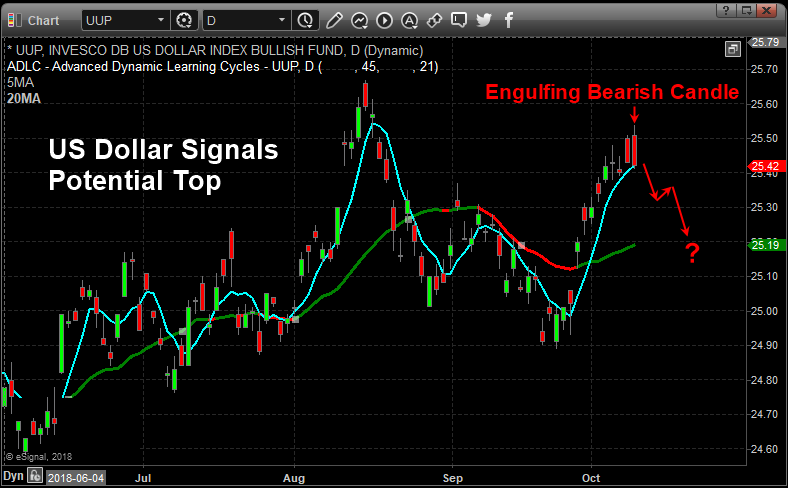
A unique setup has occurred in the Invesco DB US Dollar Index (UUP) that resembles an Engulfing Bearish type of pattern (even though it is not technically an Engulfing Bearish pattern). Technically, an Engulfing Bearish pattern should consist of a green candle followed by a larger red candle whereas the red candle’s body (the open to close range) completely engulfs the previous candle’s body. In the instance, we are highlighting in this article, a unique variation of what we’ll call a “Completely Filled Engulfing Bearish” pattern is setting up.

This is when two red candles set up in an Engulfing Bearish type of formation – omitting the requirement that the first candle is green. Japanese Candlesticks help us to identify the psychology of the market price in relation to our other specialized tools. We believe this formation is important because both of the red candlesticks that make up this pattern opened much higher than the previous bar’s close and dramatically sold off into the close of each session. We believe this type of rotation clearly illustrated that price is reaching resistance near $25.50 and pushing lower because of this strong resistance. We also believe this resistance/pattern will set up a downside price move in the US Dollar very soon.

bearish pattern

Below, we have highlighted the traditional formation of an Engulfing Bearish Candlestick pattern. The example chart, to the right of this definition, shows another variation of the Engulfing Bearish pattern setting up after three minor sideways candles. The interpretation of this Bearish Reversal pattern is subjective in terms of understanding the psychological representation of the Engulfing Bearish pattern. This pattern represents a total reversal of power within the price bar where the buyers were in control at the open (resulting in a higher opening price) and lost control through the trading session to allow the sellers to drive the price much lower into the close of the trading session. Thus, the Engulfing Bearish pattern represents a “key pivot point” in price that may prompt a larger downside move in the near future. Continue reading "Bearish Pattern Warns Of Dollar Weakness"

Saudi Crown Prince Claims Lost Iranian Barrels Will Be Offset

Back in 1973, Saudi Arabia took a very aggressive move against the U.S. by starting the Arab oil embargo:

Saudi Crown Prince

But the Trump Administration has taken a strong position against Iran, Saudi Arabia’s nemesis. KSA also depends on the U.S. for its protection as well as its economic development. The current relationship between Washington and Riyadh could not be better:

"I love working with him (Trump)." - Crown Prince Mohammed bin Salman, October 5, 2018

Saudi Crown Prince
Photo Courtesy Of AFP)

Prior to announcing the U.S. pull-out of the Iranian nuclear deal in May, the White House had secured assurances from producers, namely Saudi Arabia, that any disruptions in Iran’s exports would be offset by higher production by countries with spare capacity, according to Treasury Secretary Mnuchin. The Saudi energy minister confirmed it. Continue reading "Saudi Crown Prince Claims Lost Iranian Barrels Will Be Offset"

Onward And Upward

Apparently, the bond market just got the email that the U.S. economy is smoking and that interest rates are going up.

The yield on the benchmark 10-year Treasury note jumped 17 basis points last week to close at 3.23%, its highest level since March 2011. The yield on the 30-year bond, the longest maturity in the government portfolio, closed at 3.41%, up an even 20 bps.

The pertinent questions are, what took so long to get there, and where are yields headed next?

Analysts and traders pointed to the Institute for Supply Management’s nonmanufacturing index, which rose another three points in September to a new record high of 61.6. The group’s manufacturing barometer, which covers a smaller slice of the economy, fell 1.5 points to 59.8, but that was coming off August’s 14-year high.

Bond yields jumped further after the ADP national employment report showed private payrolls growing by 67,000 in September to 230,000, about 50,000 more than forecast. It turns out the ADP report didn’t precursor the Labor Department’s September employment report, but it was still pretty strong. Nonfarm payrolls grew weaker than expected 134,000, less than half of August’s total of 270,000, but that number was upwardly revised sharply from the original count of 201,000, while the July total was also raised to 165,000. The relatively low September figure was blamed not on a weakening economy but on the fact that employers are having trouble finding workers. Meanwhile, the unemployment rate fell to 3.7% from 3.9%, the lowest rate since December 1969.

Indeed, last week’s jobs report only confirmed Continue reading "Onward And Upward"

Gold & Silver: Get Ready For A Final Shot

Chart 1. Gold 4-Hour

LLLL
Chart courtesy of tradingview.com

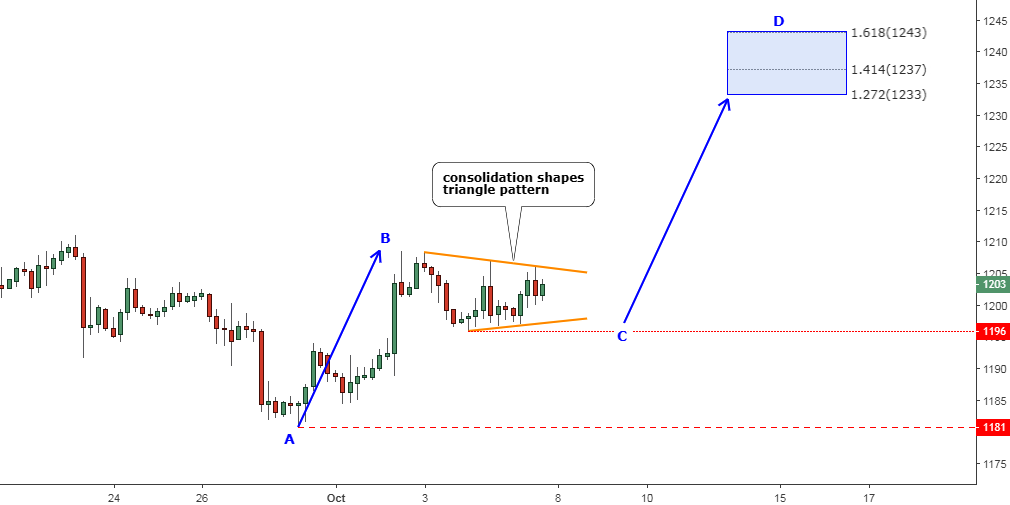
Gold has already booked more than $20 from the low established on the 28th of September at the $1181. Now, there is no doubt that the pullback I mentioned in the middle of September has been in progress.

After hitting the $1209 area, gold halted its move to the upside and started a consolidation. I marked that move as the AB segment (up blue arrow). I always mention the tricky nature of corrective structures as it may vary on the fly. The shape of consolidation could be as a counter-trend zigzag, could fit into a rectangle or form a triangle. The latter has been shaped in our chart above as the combination of lower peaks and higher troughs. I highlighted it with the converging trendlines (orange). Continue reading "Gold & Silver: Get Ready For A Final Shot"