10-Year U.S. Treasury Note Yield Eyes 3.33%

Last week I promised to update the outlook for the U.S. interest rate, which has a strong impact on every asset class including precious metals.

More than a year ago I shared with you my concerns about the future of gold once the “era of rising rates” would come. The 10-year U.S. Treasury note yield (10Y) was at 2.2%, and large investment banks forecasted 3% yield for the near future at that time.

Indeed, that future has come in one year the 10Y is above the 3% now, and it doesn’t look like it’s the final stop. To see what could be the next I’ll share with you two charts starting from a short-term view.

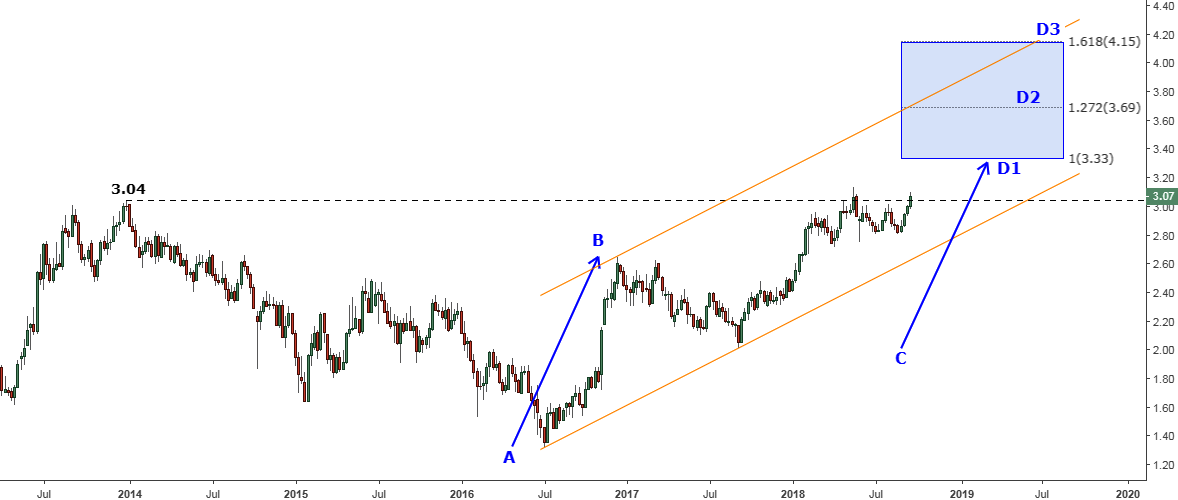
Chart 1. 10Y Weekly: 3.33% And More

10-Year U.S. Treasury Note Yield
Chart courtesy of tradingview.com

This chart above observes the past five years to envelop the earlier top of 3.04%, which is under a second attack as the first one this past May couldn’t peg it. The yield closed last week at the 3.07%, and this time it could finally overcome the barrier to reach the target.
Continue reading "10-Year U.S. Treasury Note Yield Eyes 3.33%"

IBB - Stealth Bull Market Unfolding

The iShares Nasdaq Biotechnology ETF (IBB) which serves as a proxy for the biotechnology cohort has finally broken out to a 52-week of $122 against its 52-week low of $100 in May. This 20%-plus appreciation over the summer has largely gone unnoticed while some individual companies have soared even higher over this same period. The biotechnology cohort has been decimated over the past 2-plus years over the drug pricing debate while serving as a political punching bag. To be fair, the entire pharmaceutical supply chain became a victim of harsh political rhetoric as share prices fell across all companies involved in this space in any capacity. The biotechnology cohort has been largely ignored in this massive bull market and appears relatively cheap in comparison to other sectors. As the confluence of abating political threats, drug pricing certainty, merger and acquisition activity and continuity of the current health care backdrop, this cohort has witnessed a stealth bull market. This uptrend is likely to have legs as valuations remain compelling and many names have become value stocks.

Furthermore, as the raging bull market continues into frothy territory, downside risks continue to mount. Bank of America is predicting an end to the current bull market run and in less certain times pharma companies will benefit. Individual names within the sector have demonstrated incredible strength as of recent such as Regeneron (REGN), Bristol Meyers (BMY), Allergan (AGN), Celgene (CELG), Johnson & Johnson (JNJ) and Amgen (AMGN).

Challenging 2016, Recovering 2017 and IBB’s Resurgence in 2018

After a banner year in 2015 for the biotech ETF, the cohort sold off in a dramatic fashion falling from $138 to $89 or a 37% decline. The healthcare sector had been faced with an uncertain and volatile political backdrop. As President Trump and other political pundits vowed to bring down drug prices and increase scrutiny over the sector, IBB found its footing and set a floor near the $89 level. The ~$90 level was tested a handful of times in 2016, and it was evident that many of these political threats were being priced-in after its sharp and sustained sell-off. This sharp decline and subsequent floor coincided with heated political rhetoric aimed at the collective cohort of healthcare and more specifically biotech companies. I strongly felt that these events were extraneous and would eventually subside without any significant impact on the underlying stocks within IBB. I felt this politically induced sell-off presented a great buying opportunity considering the ~40% decline and extraneous pressures. I had written about such opportunities throughout 2016 during the market sell-off and the Brexit, respectively (Figure 1). I felt that these were great entry points for any long-term investor that desired exposure to the biotechnology sector. Ostensibly, many of these stocks were trading at multiyear low P/E ratios and as a cohort (gauged via the IBB proxy) looked to be less sensitive to tweets/threats as IBB continued to test the ~$90 barrier throughout 2016. 2017 saw a nice recovery and posted a ~20% gain, and 2018 is shaping up to posting another double-digit annual return thus far the index is up ~14% YTD. Biotechnology remains one of the few sectors that money has yet to rotate into now that retail has caught fire.
Continue reading "IBB - Stealth Bull Market Unfolding"

World Oil Supply, Demand And Price Outlook, September 2018

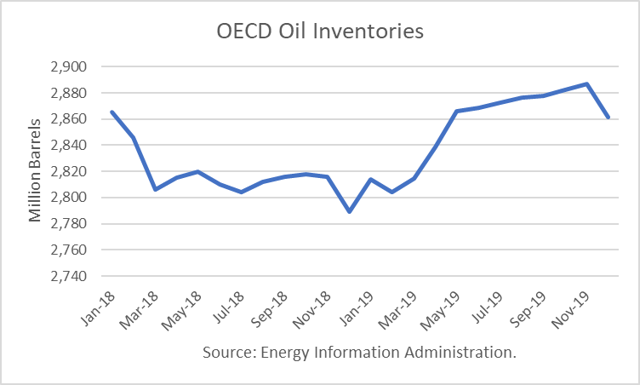
The Energy Information Administration released its Short-Term Energy Outlook for September, and it shows that OECD oil inventories likely bottomed in July at 2.804 billion barrels. It shows inventories rising in the third quarter, contrary to the usual seasonal trend. However, it forecasts that stocks will drop in December to 2.798 billion after the Iranian sanctions are expected to go into effect.

Throughout 2019, OECD inventories are generally expected to rise, ending the year with 72 million barrels more than at the end of 2017. The anticipated drop in Iranian production, due to the U.S. sanctions, is forecast to be offset by increases from other producers, such as the U.S., Canada and the Gulf states of Saudi Arabia, Kuwait and the UAE.

World Oil Supply

Saudi Arabia has recently stated that it can produce at least 12 million barrels per day. If it does increase output to that level, this would be a major “surprise” to world markets since its production has never exceeded 11 million. Continue reading "World Oil Supply, Demand And Price Outlook, September 2018"

Are Technology And FANG Stocks Bottoming?

Recent downside pricing pressure on Technology and FANG stocks have kept investors wary of jumping back into the market while we wait to see where the bottom may form. Concerns about long-term pricing pressures, US trade wars and the continued Congressional testimony regarding privacy and censorship issues have kept social media technology stocks in a negative perspective. The only aspect of this pricing pullback that is positive is that these stocks will, at some point, find a price bottom and attempt to rally as investors rush back into their favorites attempting to ride the run higher.

Our researchers believe the current price levels could be a prime example of a short-term bottom setting up in certain technology stocks. Both Apple and Amazon are two of the biggest and most actively traded stocks on the US Stock exchange. They differ from many of the other FANG stocks because these companies actually produce and sell consumer products & services that are, in many ways, essential to conducting commerce and trade.

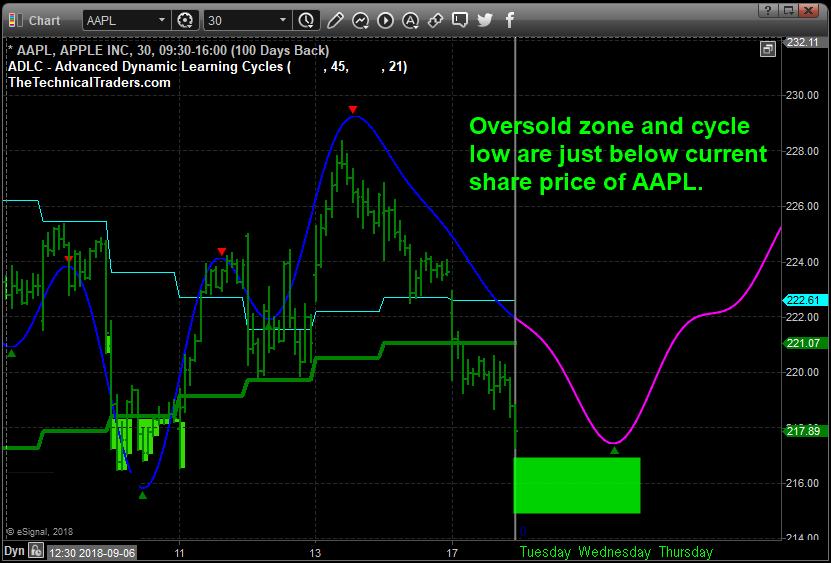
This 30-minute chart of Apple shows our Adaptive Dynamic Learning Cycles price modeling system showing a cycle low is setting up over the next day or two in Apple followed by an upside price cycle that should push prices back above $220. Notice the oversold levels highlighted in BRIGHT GREEN. The last major oversold levels setup just below $218. The current oversold levels are setting up just below $217. We believe these $217 levels will likely set up a price bottom and prompt an upside price rally over the next 5+ days that could push Apple prices well above $225.

FANG Stocks

Amazon is setting up a different type of price bottoming formation – a Fibonacci price retracement bottom. We use these Fibonacci price retracement levels in conjunction with our other price modeling systems to attempt to determine where and when price reversals may be set up in the future. In this example, we can see a price bottom formed in early August of a Fibonacci 50% price pullback and the current price pullback is testing the same 50% level. We believe this current setup will prompt a price bottom to form and an upside price rally will likely result in AMZN rushing back above $2000 again with a few days. Continue reading "Are Technology And FANG Stocks Bottoming?"

Gold Struggles While Silver Doesn't

In this post, I will take a deep dive into the chart structure of the precious metals as prices approach crucial triggers but on the opposite sides of each metal.

Let’s start with gold as it struggles to gain a foothold above $1200.

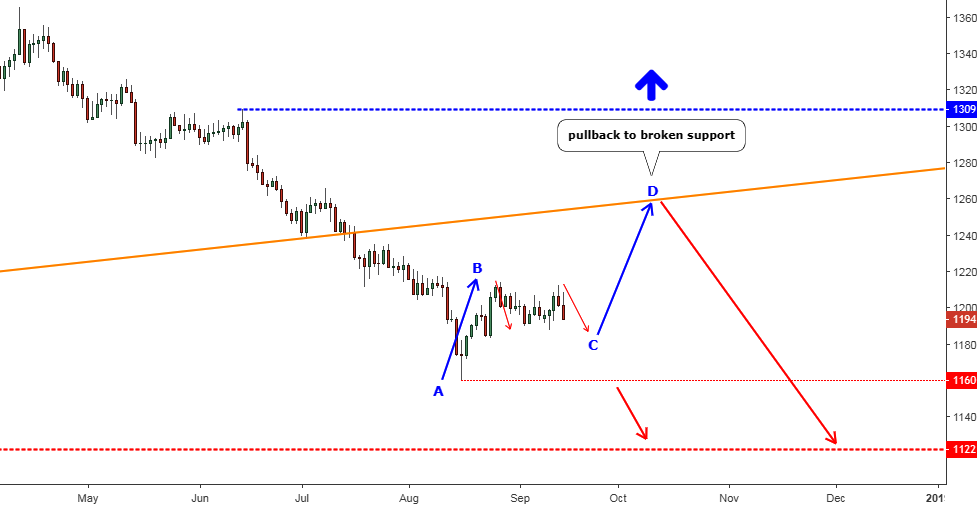
Chart 1. Gold Daily: Pullback

Gold Struggles
Chart courtesy of tradingview.com

The votes were split almost evenly in the poll in my earlier post about the gold’s outlook. Half of the readers chose the trigger of the upside resistance at the $1218 and the rest thought that the market would drop to retest the $1122. The metal price then was just a little bit lower than these days at the $1186.

Almost one month has passed since then, and to my surprise, none of the triggers were pulled although we were very close to the $1218 point, the market couldn’t push above the $1214 at the end of the August and then retreated below $1200. This month we could see the increasing activity as investors are back from their summer holidays. There was another attempt to clear the resistance last week, but it stalled at the $1213 and the significant level again remained untouched. Continue reading "Gold Struggles While Silver Doesn't"